Journal


Chapter 5 – Summary of recommendations


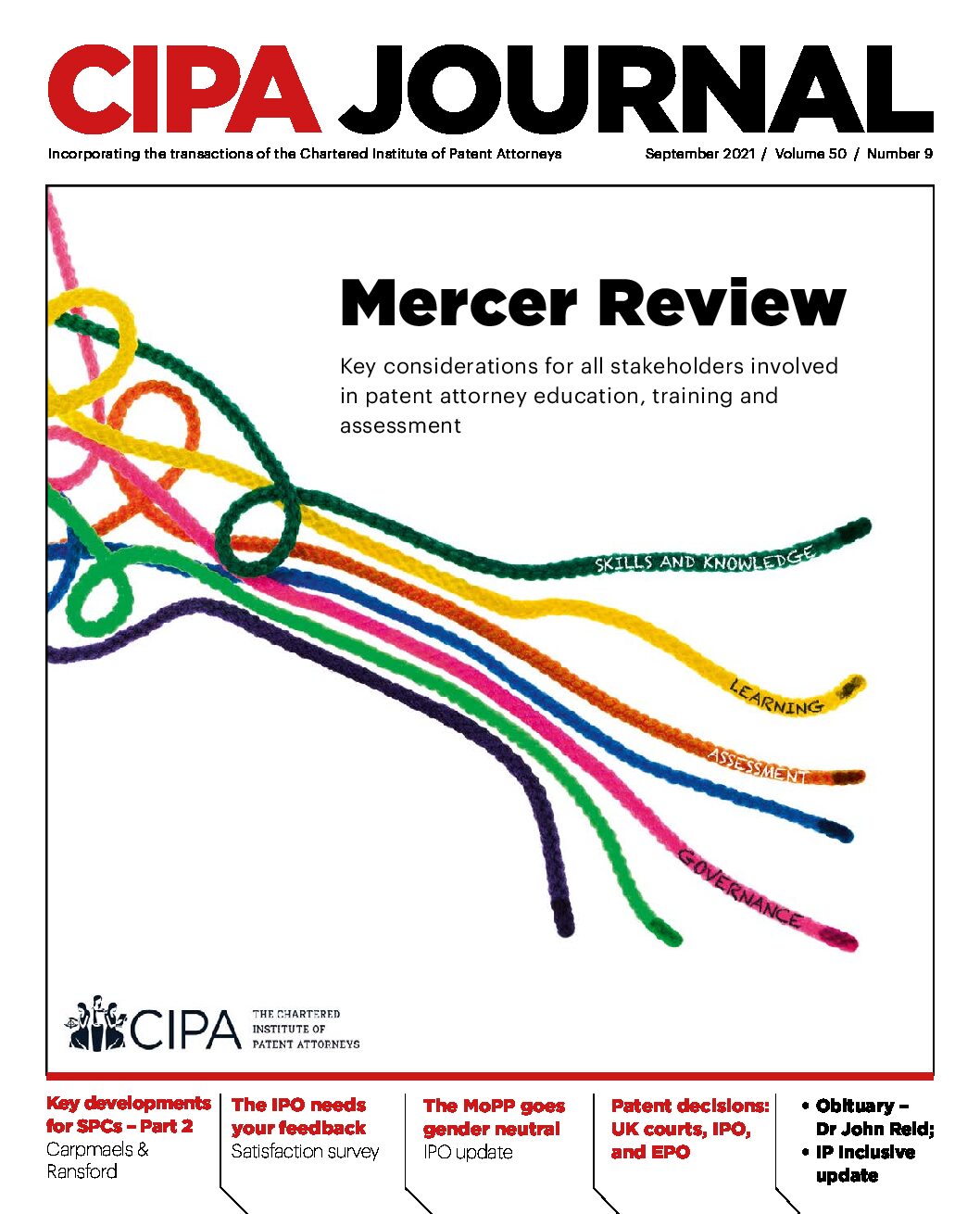
Mercer Review: Chapter 5 – Summary of recommendations

1. Recommendations from Chapter 1
  1. The Foundation Certificate examinations should focus on the core knowledge and skills required by a patent attorney. This will include some basic knowledge of trade mark, design and copyright law, but this should be commensurate with what a patent attorney is likely to face in day-to-day practice.[1] However, the syllabus should include all the ‘black-letter’ law (basic standard elements or principles) which is relevant for the LSC, so that this law does not need to be duplicated by the LSC;
  2. The scope of the International Law syllabus be revised to focus on core areas (EP, PCT, US, JP, CN) and instances where there are significant/important differences in patent law (e.g. 30 vs 31 month national phase entry, allowability of method of treatment or second medical use claims, allowability of computer programs as such). Questions should be structured to give sufficient choice for candidates working in different sectors, where the relative importance of countries may differ. We also questioned to what extent it is necessary to examine international law relating to trade marks, designs and copyright;
  3. All candidates should have a good knowledge of professional ethics prior to registration, and before undertaking the LSC; and
  4. All candidates should have a good knowledge of evidence for the UK court system as it applies to patents and before undertaking the LSC.
  5. FD2 should be limited to drafting a patent application, relating to generally-accessible technology, suitable for filing at the IPO in a form where the claims are clear, novel and arguably inventive over the prior art presented in the question and where the description is sufficient;
  6. FD3 should be limited to answering an official letter from the IPO which raises novelty and inventive step objections and providing a set of claims which deals with the objections and which does not add matter or lack clarity;
  7. FD4 should be limited to requiring the candidates to demonstrate that they can construe a set of claims according to the case law in the UK, evaluate prior art, determine whether the claims as construed are novel and inventive over that prior art and determine whether the activities of a potential infringer are infringing acts under UK law and should not require detailed advice on points not relevant to the main topics;
  8. FD1 should not cover any of the areas covered by the other examinations but should include at least one question about a situation which could arise in litigation of a patent in the UK courts, involving application of the black-letter law on litigation which should be part of the FC syllabus (see above); and
  9. Similarly, FD2, FD3 and FD4 should not require advice on points which are examined in FD1.
  10. Any changes to the syllabi for the Foundation and Final examinations should be reviewed to ensure that, as far as possible, they encourage an increase of diversity and inclusion in the profession.
2. Recommendations from Chapter 2
  1. CIPA should provide better information on its website about what is required to enter the profession and to progress in the profession and keep such information under review;
  2. CIPA should provide such information to careers services;
  3. The PEB should make its website easier to navigate;
  4. IPReg should require registrants to make available to any possible recruit details of the training scheme which the recruit will follow, preferably in the form of a training contract; and
  5. The Informals should continue, with the support of CIPA, its efforts to assist possible recruits in understanding such information.
  6. A common examination should be passed by all candidates at each stage.
  7. IPReg should accredit the syllabi for the FC and FD examinations and the PEB for setting the FC and FD examinations;
  8. IPReg should require all candidates to take the PEB FC and FD examinations;
  9. Any provider should be allowed to provide training for the FC and FD examinations without requiring any accreditation; and
  10. CIPA and the Informals should co-operate to determine what formats of training are lacking and encourage providers to provide such training.
  11. CIPA and IPReg should encourage its members and registrants to adopt career progression systems which are not solely linked to examination success and training systems which encourage candidates to make use of the modular system so that they take any particular examination only when they appear to be ready to take that examination.
  12. The LSC course should be cut down to the practical matters of advocacy and the preparation for advocacy; and
  13. The black-letter law content of the LSC should be transferred to the FC syllabus and examination, the application of the black-letter law in giving written advice to a client should be transferred to the FD1 syllabus and examination and the practical aspects of the course should be retained in a reduced assessed LSC.
  14. There should be a CPD requirement for all registrants and it should be compulsory to report on meeting the CPD requirement to IPReg. We consider that the onus for carrying out CPD should be on each registrant individually and that each registrant should be prepared to provide details of her or his CPD to IPReg on a random basis.
  15. There should be opportunities for registrants to expand their areas of expertise but these should generally be voluntary. We welcome CIPA’s decision to make all its webinars more widely available and to expand the scope of the webinars. IPReg and CIPA should also encourage other providers to offer training in non-examined areas.
  16. IPReg, CIPA and CITMA should investigate whether there should be a route to registration as a trade mark attorney other than via a university course, for instance by an advanced examination at the same level of the FD examinations or by following an assessed training course.
  17. As regards practical litigation skills, it is considered that it should be compulsory for all registered patent attorneys to complete an assessed course on this subject. However, this course should be limited to the practical aspects of litigation skills and that the other parts of the present course should be incorporated into the FC and FD syllabi and examinations (see above).
  18. As regards higher court advocacy, we consider that the training for this subject should remain as it is, with a requirement to follow an assessed training course before the grant of a certificate.
3. Recommendations from Chapter 3
  1. IPReg, CIPA and the PEB investigate whether early registration of candidates should be implemented.
  2. Qualification for the Foundation Certificate should be via the PEB FC examinations, with all course providers teaching to the same syllabus.
  3. The PEB has as a continuing task of ensuring that the content of each FD examination remains limited to its core area; and
  4. The PEB has a continuing task of ensuring that the length of all the FD examinations is maintained in a defined size range from year to year.
  5. The PEB does not make available marking schedules (as occurs with the EQEs) to candidates but provides more detailed examination reports and provides train-the-trainer sessions immediately after release of the results for any FD paper; and
  6. The PEB should make it clear that, for each of papers FD2, FD3 and FD4 and for each questions in paper FD1, the examiners are looking to see whether the answer as a whole merits a passing mark so that candidates do not concentrate on ‘mark gathering’.
  7. When taking the FC and FD examinations, candidates should have read-only access to a limited selection of sources to be determined by the PEB.
  8. The FC and FD examinations should continue to be provided in electronic format and should use the same system as is used for the EQE.
  9. The PEB, together with IPReg and CIPA, should investigate the use of the electronic examination system used for the EQE to see whether it can be adapted to meet the requirements of the FC and FD examinations and allow read-only access to selected sources;
  10. The PEB should adapt the examinations and marking schedules as necessary so that the maximum working time for any examination can be limited to four working hours, excluding any additional time that is required for e.g. students with reasonable adjustments, breaks, or uploading/downloading time; and
  11. The PEB and IPReg should consider whether the invigilation system used by the system is sufficient.
  12. The PEB, IPReg and CIPA should encourage employers to support their candidates in effective use of the modular examination systems without affecting career progression; and
  13. The PEB, IPReg and CIPA should look at the scheduling of the UK examinations once more is known about how the proposed changes to the EQEs will be implemented in 2024 and beyond, so as to avoid potential clashes.
  14. The PEB, IPReg and CIPA should investigate whether having two sittings a year is a practical proposition.
  15. The examinations should be spread over two weeks so that there is a gap of a day between each FD paper and there is only one FC paper per day.
  16. IPReg, with the assistance of the PEB and CIPA, should investigate whether the exemptions from FD2 and FD3 in light of a full pass of the EQE are appropriate.
  17. Any changes should be reviewed to ensure that, as far as possible, they encourage an increase of diversity and inclusion in the profession
4. Recommendations from Chapter 4
  1. IPReg should review, with CIPA, the requirement for the PEB to be independent of CIPA in terms of its governance and financial control.
  2. IPReg should create a set of occupational standards for patent attorneys.
  3. IPReg should test the agility of the existing examination system, to ensure that it can be responsive to a rapid change in the skills and knowledge required by the patent attorney profession.

Footnote

  1. However, for attorneys wishing to develop further knowledge in these areas, additional training should be provided by way of non-examined courses, e.g. e-learning modules or in-person training courses.

Featured Articles
Council news
News
Decisions
Articles
Personal

Other Recent Issues

Shopping Bag (0)

No products in the cart.