

- News
- News
- NewsMedia
- Events
- Events
- EventsIntroductory Patent Paralegal CourseAdvanced Patent Paralegal Course (APPC)
- Advice
- Advice
- IP explainedResources
- Members
- Members
- MembershipBrand & Marketing Materials
- Publications
- Publications
- Online ShopCIPA JournalDownloads
- Jobs
- About Us
×Journal
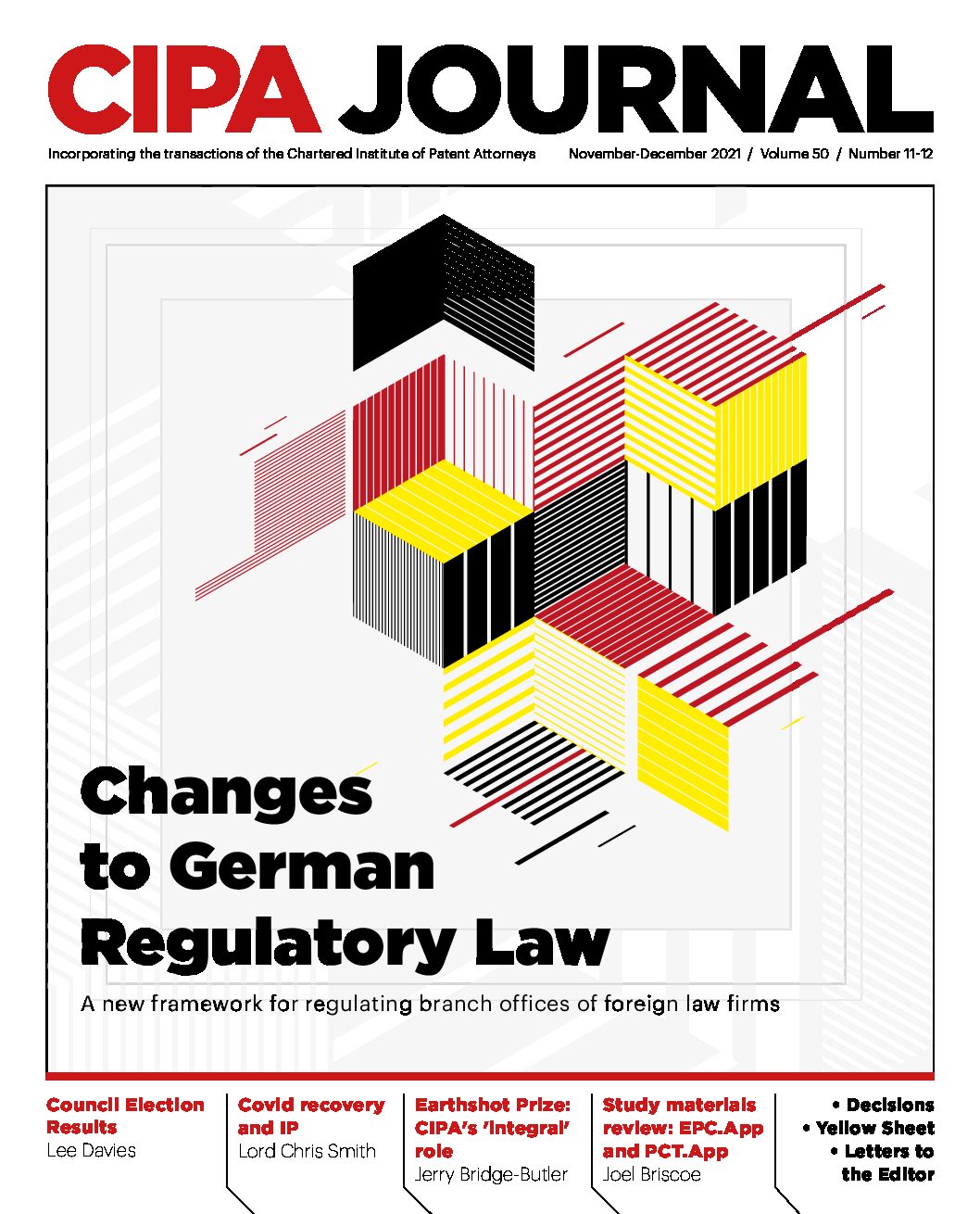
Covid recovery
We are, we all fervently hope, beginning to emerge from the worst impacts of the Covid pandemic. Economic life isn’t exactly back to normal, but it is heading in the right direction. But a combination of Covid and Brexit has ravaged our economy, and continues to do so. Supply chain crises, staffing shortages in many sectors, export difficulties: we aren’t in terribly good shape. We do, however, have to try and make the best we can of where we find ourselves. Bewailing how we got here (which I frequently do) isn’t particularly helpful.
It has been heartening to hear that trade mark and patent activity has been reasonably vigorous over the past 18 months.
The hope, though, has to be that it is intellectual property that will provide the greatest help towards recovery. It isn’t too far-fetched to say that it is patents and trade marks that will in the long run make the greatest difference to our economic future. It is innovation, and the legal framework that underpins it, that will be the most important ingredient of that future. And in this respect it has been heartening to hear that trade mark and patent activity – and the demand for service from attorneys in both fields – has been reasonably vigorous over the past 18 months, despite the rigours of the pandemic and accompanying lockdowns. It varies, of course, from sector to sector and firm to firm, but my worst initial fears about a falling-off of activity don’t seem – so far at least – to be being realised.
There was some mixed news for the world of intellectual property in the recent Budget. Looking at the announcements on research and development, there were some welcome bits and pieces. The extra £400m for Innovate UK was one of these. The £800m announced – albeit spread over five years (it’s the oldest trick in the Treasury book, announcing five years’ worth of money as if it’s one) – for the new “Aria”, the Advanced Research and Invention Agency, was encouraging. This agency was apparently the brainchild of Dominic Cummings, and everything will crucially depend on the specifics of how it is set up, what its remit is, and how it operates. The devil, as always, will be in the detail.
The underlying picture isn’t as good, however. We had originally been promised an overall total of government support for R & D of £22bn a year by 2024/5. That target has now been pushed back to 2026/7, two years later. Chancellors (of all stripes) do tend to be rather good at committing to funding many years in advance, and then subsequently adjusting the dates.
Government funding matters, of course, because a lot of publicly-funded research spins off into new ideas and products that get taken up by the private sector and need patent or trade mark protection. But the central point remains very clear, and very important, and I do wish the government had gripped it more firmly: if we are going to build our way out of the economic malaise, it’s the things that contribute to intellectual property, and that need to be protected by IP law, that will lead the way. Let’s not forget the sheer importance of this mission, which we are all embarked upon.
Lord Chris Smith, Chair of IPReg, November 2021
Featured ArticlesChanges to German Regulatory Law
Miles Haines (Fellow)
Council Election Results
Lee Davies, Chief Executive
The government makes explicit its commitment to the EPC in trade negotiations
Neil Lampert, Deputy Chief Executive
UpfrontCovid recovery
Lord Chris Smith, Chair of IPReg
Council Minutes, October 2021
Lee Davies, Chief Executive
Council Election Results
Lee Davies, Chief Executive
NewsOverseas update
Amanda R. Gladwin
The IPO needs your feedback
IPO
The government makes explicit its commitment to the EPC in trade negotiations
Neil Lampert, Deputy Chief Executive
ArticlesCIPA’s ‘integral’ role in the Earthshot Prize
Changes to German Regulatory Law
Miles Haines (Fellow)
DecisionsPatent decisions – EPO
Bristows
Patent decisions – UK courts
Beck Greener
Patent decisions – UK IPO
David Pearce and Callum Docherty
Trade mark decisions – EUIPO
Bird & Bird LLP
Trade mark decisions – UK
Bird & Bird LLP
PersonalAnnouncements
CIPA
IP Inclusive update
Andrea Brewster OBE
How do you want to receive your Journal?
CIPA
Members list 2.0 – opt in for others to find you
CIPA
Yellow SheetYellow Sheet – Introductions
Informals Committee
Regional secretaries
Informals Committee
In-house trainee chat
Ellie Lee
Informals Committee – contact details
Informals Committee
EQE Tutorials
Informals Committee
Coffee Club
Laura Cassels
Study Materials Review: EPC.App and PCT.App
Joel Briscoe
Other Recent Issues
June 2026
May 2026
April 2026
March 2026

January-February 2026
December 2025
November 2025
October 2025
Shopping Bag (0)