Dr Zhivago, literary copyright, and the fundamental distance between works of historical fact and fiction
Carpmaels & Ransford


In response to feedback from CIPA on the lack of official guidance on sets of articles, the UK IPO referred to four decisions relating to products consisting of multiple components. While these are not recent decisions, CIPA’s Designs & Copyright Committee wanted to bring these decisions to members’ attention.
By Joshua Green, Josh McLennon and Robin Lloyd (Kilburn & Strode LLP). Robin Lloyd is a member of CIPA’s Designs & Copyright Committee.
The decision relates to an application by Training Mask LLC to invalidate UK registered design no. 5001809 in the name of Gorge Limited. The decision focused on what the applicant of the contested design was actually seeking protection for, and how this informs the relevant prior art.
Background
Gorge Ltd filed a design for a ‘High Altitude Training and Fitness mask’ on 29 February 2016, consisting of the five views shown below.
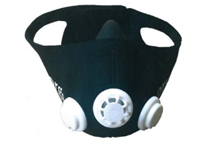
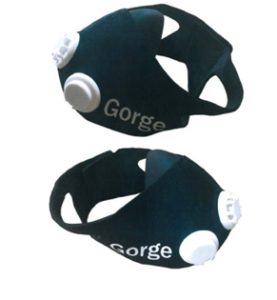
FRONT VIEW SIDE VIEWS
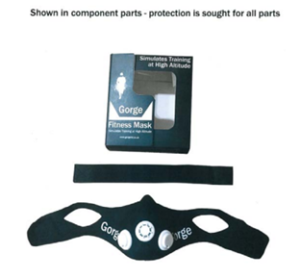

FOURTH VIEW FIFTH VIEW
On 23 June 2017, Training Mask LLC (the applicant) applied for the registration to be declared invalid on the basis that the contested design, apart from the text on the mask, is a copy of the Training Mask 2.0, a product invented by the CEO of Training Mask LLC and protected in an earlier patent application, and therefore does not meet the novelty requirements of section 1B of the Registered Designs Act. The patent application was published in the USA on 30 June 2015, and it was accepted that the Training Mask 2.0 went on sale in the UK in or around 2012.
The applicant also claimed that, apart from the text, the packaging is a copy of the packaging used for the Training Mask 2.0. The applicant highlighted the fact that the shape of the packaging is the same and that both designs include the same ‘L’ shaped flap at the front. The applicant included the following images of the Training Mask 2.0 in their evidence:

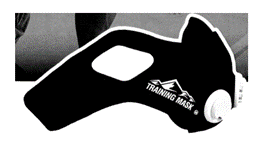
TRAINING MASK 2.0, INCLUDING PACKAGING, AS DISCLOSED BY COMMERCIALISATION IN UK.

US PATENT DRAWING – EXCLUDING SURFACE DECORATION AND PACKAGING.
Scope of the Design
When considering the request for invalidation, the hearing officer first had to determine what the contested design sought protection for. They noted that the front and side views were consistent with the description of the product i.e. High Altitude Training and Fitness mask. However, the fourth view showed the component parts of the mask and the front view of the packaging and the fifth view showed the mask in the packaging.
Gorge Ltd tried to clarify that the design was for a ‘complex product’ i.e. the mask in its packaging (as shown in the fifth view). The hearing officer did not accept this assertion, because the packaging for the mask is clearly not a replaceable component part permitting disassembly and reassembly of the product.
Instead, the hearing officer advised that the design would be treated ‘as consisting of the visible features of the face mask (both in and out of its packaging) as well as the visible features of the packaging shown in views 4 and 5 of the contested design’.
Closest prior art
After establishing the scope of the design and in order to determine if the contested design was new and possessed of individual character, the hearing officer was required to determine which piece of prior art it was most appropriate to compare the contested design to.
The applicant requested that the hearing officer compare the contested mask with the US patent drawings which did not include packaging and, separately, the contested packaging with the packaging for the Training Mask 2.0. However, the hearing officer refuted this request, reminding the applicant that it is not appropriate to mosaic features from different disclosures together and pointing out that such an analysis would be similar to saying the contested design is actually two separate designs – one directed to the mask and one directed to the packaging. This would not be in line with the applicant’s earlier submissions that the contested design is a single design.
As only the commercial UK product contains packaging, the hearing officer advised that the applicant’s best case for invalidation would be based on the Training Mask 2.0, as opposed to the design shown in the US patent drawing and, on that basis, he proceeded to try and determine whether the two designs created the same overall impression on the informed user.
Overall impression on informed user
In relation to the shape and configuration of the mask, Gorge Ltd argued that all the visible features of the contested design were wholly functional. The hearing officer did not agree with this and thought that the designer had at least a small degree of design freedom – this was apparent in, for example, the number and arrangement of the valves on the front of the contested mask, the decision to leave the valves visible, the shape of the ear holes and the width of the mask at the point at which it passes round the back of the user’s head. These features were all remarkably similar to those on the Training Mask 2.0.
The hearing officer also highlighted that both the contested design and the Training Mask 2.0 have a high degree of contrast between the dark colour of the mask and the light colour of the valves – even though no colours are claimed in the contested design, the contrast is a relevant factor which the hearing officer considered when assessing the overall impression.
In relation to the branding on the masks, the hearing officer stated that he did ‘not dissent from the general proposition that the branding on any product is meant to be noticed’. However, in the hearing officer’s opinion, the informed user would be more likely to concern themselves with how the mask looks and fits when worn, as opposed to the branding on the mask. The branding on the Training Mask 2.0 therefore would not dominate the overall impression.
In relation to the shape and configuration of the packaging, the hearing officer held that the ‘L’ shaped opening flap extending across a portion of the front of the packaging of the contested design was the most striking feature of the packaging’s shape and configuration.
When considering the surface decoration on the packaging, the hearing officer explained that much of the text on the boxes was banal and was unlikely to contribute much to the overall impression created by the design – it was shared between the contested design and the Training Mask 2.0 packaging, the text is in an everyday font and it simply states what the product does.
The hearing officer concluded by saying that the contested design created the same overall impression on the informed user as the prior art design because of the identical shape and configuration of the masks, the similar contrast between the dark shade of colour used for the masks and the light colour used for the visible valves and markings, and the same ‘L’ shaped opening flap – features which the hearing officer deemed would contribute the most to the overall impression the designs made on the informed user. The hearing officer therefore found the contested design to be invalid and it has since been cancelled.
Interim Design Decision O/217/20, 8 April 2020
This was an interim decision by the Appointed Person, Mr Martin Howe, on an appeal from decision O/699/19 by the hearing officer to allow an application by GBL UK Trading Limited to invalidate four registered designs (Registered Design Nos. 5002463, 5002464, 6009459 & 5002467) in the name of H&S Alliance Ltd.
The designs each related to a ‘Castor wheels set’. Three of the designs consisted of two castor wheels, one braked and one unbraked. A fourth design, in addition to braked and unbraked variants, also showed two different attachment mechanisms. A view from one registration is shown below.
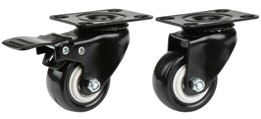
Design No. 5002464
The hearing officer had held that all four designs lacked individual character based on prior art disclosed on amazon.co.uk. One example of the prior art relied upon is shown below.
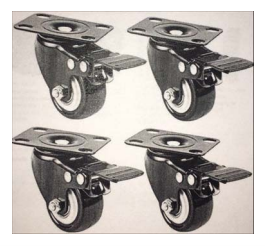
While the hearing officer agreed with the proprietor’s representative that the novelty in the design, which comprised braked and unbraked castor wheel versions, cannot be destroyed by two separate pieces of prior art, the hearing officer found that with the only difference being the inclusion/omission of a largely functional brake, the informed user would view the registered design as having the same overall impression as the prior art and the novelty would thus still be destroyed.
In the appeal, the proprietor’s representative argued that the registered designs, which are each formally described on the Register as a design for a ‘Castor wheel set’ depict a set of two castor wheels, one braked and one unbraked. While there are clearly functional aspects to the differences, there are also aesthetic differences – notably the presence or lack of a brake pedal. The representative argued that to give the same overall impression, the prior art would need to show at least one braked castor wheel and one unbraked castor wheel.
Mr Howe was of the view that the statutory basis for the registrability of a set of articles was not clear and that a design registration can only contain representations of a single ‘product’. While the reference to ‘set of articles’ contained in the Registered Designs Act 1949 was repealed in order to conform UK law with the provisions of the Designs Directive 98/71/EC, both the UK IPO and the EUIPO guidance indicate that sets of articles may be registered. EUIPO guidance requires that ‘At least one view must show a set of articles or a complex product in its entirety’.
Mr Howe referred to the IPO’s Registered Design Examination Practice in relation to ‘sets of articles’. This describes that a set of articles can be a ‘product’ in its own right and can be represented in a single design application if the articles making up the set are linked by aesthetic and functional complementarity and are, in normal circumstances, sold together as one single product. At least one view must be submitted which shows the set of articles in its entirety.
Another argument put forward by the proprietor’s representative was that a set of castors would be assembled into a complex product being the trolley or other item to which the castors will be attached and the definition of a ‘product’ included ‘parts intended to be assembled into a complex product’ such that registration of a group of parts for a single product should be permitted.
While the hearing officer had felt constrained to proceed on the basis that the registration was not invalid on the ground of containing multiple product designs, Mr Howe felt it necessary to clarify the approach to be adopted when comparing a set of braked and unbraked castors to an item of prior art showing only castors with braked wheels and also the basis on which each of the registered designs containing multiple items was valid, if it was valid.
Mr Howe took the unusual course in inviting the respondent to amend their invalidation applications to raise the issue of sets as a ground of invalidity. The proprietor was given a full opportunity to respond to this new ground. The IPO was also invited to make submissions regarding its current practice. Mr Howe set out certain points and issues which he felt arose in order to guide the parties without coming to any conclusions and made directions for the further conduct of the appeal.
Design Decision O/374/21, 17 May 2021
Following the Interim Decision O/217/20, this was the final decision after consideration of the parties’ submissions as well as the submissions from the IPO.
As part of its submissions in response to the Mr Howe’s invitation, the UK IPO identified Case T-9/15 Ball Beverage Packaging Europe Ltd v EUIPO [2017] and paragraphs [60-62] and summarised its submissions as follows:
The proprietor’s representative criticised the IPO’s conclusions and the EUIPO’s examination guidelines on which they were based, in particular, that the test of aesthetic or functional complementarity is not found anywhere in the Act or in the Designs Directive and that there should be a broad interpretation under which there is no limitation on disparate items being included together as a single product within a single design registration.
Mr Howe rejected the submission that any two (or more) unrelated items can be put into a design application together and must thereafter be treated as a single ‘product’ carrying, as a necessary corollary, a single ‘design’ embracing the features of appearance of each component. On the other hand, Mr Howe was of the view that it did not seem that the concept of a ‘product’ means that it must always consist of one physical object, or of objects physically joined together.
Mr Howe considered that where a product consists of a single physical item, there is no requirement that the different parts of the design should complement each other either aesthetically or by way of function even if that might be a desirable characteristic, as long as it satisfies the essential requirement that the items are sold together as a unitary product and remain together as a unitary product in normal use. Mr Howe further considered that the presence of aesthetic and/or functional complementarity may well make it easier to characterise the group of items as being a unitary product, but did not see the justification for making this a requirement, still less for imposing what appear to be two cumulative requirements relating to both aesthetics and function.
Mr Howe considered that each of the components within each of the registrations in issue, if they in other respects satisfy the requirements for being regarded as a single product, did possess the features of aesthetic and functional complementarity. In each registration, the braked and unbraked variants have designs which, leaving aside the presence or absence of the brake, are coordinated with each other. The items in each set will functionally complement each other, by holding up different corners of a piece of furniture, if indeed the set is used for this purpose.
The decision
The validity of registered design no. 5002463 which comprised a four-wheel set and included views with different mounting arrangements in the form of mounting flanges and mounting threads was looked at.
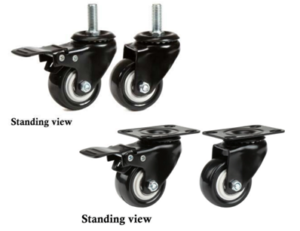
Design No. 5002463
None of the prior art showed such a combination of mounting arrangements in a single set but Mr Howe was of the view that such a combination was implausible to use or to sell and that the castor wheel in this registration was intended to be put into separate and different complex products. Mr Howe held that design 5002463 did not amount to a single product and thus did not comply with the definition of ‘design’ in section 1(2) of the Act and was invalid. Mr Howe, however, did hold that the remaining three designs which were the subject of the appeal did fulfill the definition of ‘design’.
Mr Howe then considered the three grounds of alleged error in the hearing office’s decision relied upon by the proprietor.
In relation to registered design no. 5002464, Mr Howe considered that the informed user would appreciate that the absence of the brake on one of the two castors in the registered design arises as the result of a difference in functional requirements. Whilst the absence of a brake on one of the pair in itself leads to a difference in appearance of the set from the prior art, the informed user would largely discount the significance of this difference in forming an overall impression of the respective designs. Mr Howe believed that this difference was not sufficient, when viewed in this way, to lead to a different overall impression, any other differences being extremely minor. Mr Howe concluded that the hearing officers had not erred in the assessment in which the differences in the brake would be largely discounted in terms of the overall impression.
In relation to registered design no. 5002467, while the proprietor’s representative had pointed to the fact that in the registered design, there is a darker inner ring and a lighter outer ring on the wheels, whereas in the prior art the light and dark tones are reversed, the hearing officer had assessed the difference in shading as being a minor detail which does little in any event to create a different overall impression, and assessed the brake shapes overall as being similar with minor differences. Mr Howe concluded that the proprietor’s criticisms did not come near to demonstrating a basis upon which the hearing officer’s assessment of overall impression should be set aside on appeal.
Finally, in relation to registered design no. 6009459, there were similar differences with the prior art in the reversal of dark and light bands to the two-tone wheels and the shape of the brake. For the same reasons as for registered design no. 5002467, Mr Howe rejected these criticisms of the hearing officer’s assessment. In addition, Mr Howe agreed with the hearing officer’s assessment in discounting the difference in ‘domed fixings’ which were heads of rivets as minor differences.
Mr Howe upheld the hearing officer’s finding that all found registered designs are invalid although in relation to design no. 5002463 on a different ground, namely that it was not a design which related to a product. The appeal was dismissed.
Ball Beverage Packaging Europe Ltd v EUIPO, Case T-9/15, 13 June 2017
The contested design was Community design number 2309900006, registered 24 September 2004 with respect to ‘[beverage] cans’.
The application by Ball Europe GmbH for registration of the contested design was made in Germany with English indicated as the second language. The description of the design was entered in English, as follows: ‘Group of cans for drink, all having a sleek but high appearance with reduced neck, preferably made of thin sheet metal, especially for filling volumes of 250 ml, 300 ml or 330 ml, respectively.’
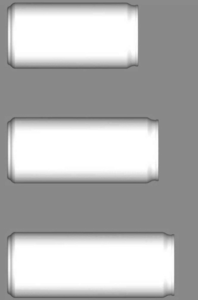
Background
In February 2011, the intervener, Crown Hellas Can SA, had filed an application for invalidity on the grounds of the design not being new (Regulation 6/2002 article 5) or having individual character (Regulation 6/2002 article 6), offering images of three prior art cans (seen below) as being identical to the design in question.
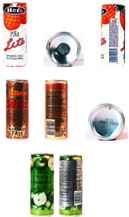
The application for invalidity was rejected in June 2012, the Cancellation Division finding that the contested design did indeed have the required novelty and individual character over the prior art. The intervener then appealed the rejection of its application for invalidity.
In September 2014, the Third Board of Appeal of the EUIPO annulled the decision of the Cancellation Division and found the design to be invalid on the ground of it having no individual character. Citing Regulation 6/2002 article 98(1), the Board of Appeal refused to take into consideration the description, in English, which specified that the design was for a group of cans, on the ground that the description had not been made in the language of application (German) chosen by the applicant. Accordingly, the Board of Appeal found the cans to have no individual character based on the differences between the contested design and those of the prior art being insignificant and having no impact on the overall impression of the informed user, who was defined as persons in the drinks industry responsible for bottling.
Ball Beverage Packaging Europe Ltd, replacing Ball Europe GmbH, brought action against the 2014 decision of the Board of Appeal, requesting that the decision be annulled, which was heard before the General Court (First Chamber).
First plea
The applicant claimed that the Board of Appeal did not sufficiently state the reasons on which its decision was based that the informed user knew the usual sizes of beverage cans and does not attach importance to the different sizes thereof, in line with article 62 of Regulation 6/2002. This decision was felt by the applicant to be of primary importance to the Board of Appeal’s overall decision to declare the contested design invalid.
The General Court found that the decision was indeed supported throughout by reasons to the requisite legal standard, including statements relating to the capacity of the cans, the informed user being the bottler, and why neither the dimensions nor the capacity of the could be deduced from the contested design. Thus, the first plea was rejected as unfounded.
Second plea
The applicant alleged an infringement of the combined provisions of articles 25(1)(a) and 6 of Regulation 6/2002. The General Court divided this plea into two parts: a first alleging that the Board of Appeal incorrectly assessed the scope of protection afforded by the contested design, and a second relating to the Board of Appeal’s allegedly incorrect assessment of the individual character of the contested design.
First part of second plea: unitary product
Article 3(a) of Regulation 6/2002 states that the subject matter of a design could only be a unitary object, and that the combination of several unconnected products could be assessed as one article only when those parts are linked by aesthetic and functional complementarity and are usually marketed as a unitary product.
The Board of Appeal found that the contested design did not satisfy the conditions given in article 3(a) and could not be considered as a unitary object. Instead, for the assessment of novelty and individual character, the design would be considered as an individual can represented in three different sizes. The applicant had three main complaints regarding this, namely that the Board of Appeal refused to protect the contested design as a group of cans despite being registered as such, the Board of Appeal incorrectly found the contested design was not ‘a product’, and that the description in English (beginning ‘A group of cans…’) of the contested design was not taken into account.
Regarding the first complaint, the General Court found that the lack of substantive examination on registration of designs by the EUIPO points towards the Board of Appeal not being bound by the EUIPO’s possible position as to the subject matter of protection.
The second complaint was then dismissed as the Board of Appeal was not found to have made any error in determining the contested design not be ‘a product’ as the three cans in the contested design are not sold together, and do not perform a common function which cannot be performed by each of them individually.
Finally, the Board of Appeal correctly refused to take the description into account, as article 1(2)(a) of Regulation 2245/2002 provides that the description may not contain statements as to the purported novelty or individual character of the design or its technical value. The General Court found that it followed that the description may not influence the question of the subject matter of the protection afforded by the design at issue, which is connected to such assessments.
Second part of second plea: individual character
The definition of the informed user as the person who, in the drinks industry, was responsible for bottling the beverages, and limitations on design freedom of the designer by the Board of Appeal were not objected to, and thus were approved.
The General Court compared the overall impressions produced by the three cans represented in the contested design, and the overall impression produced by the cans in the prior art. It agreed with the Board of Appeal that even if the informed user noticed differences between the proportions, they would have had no effect on the overall impression. The Board of Appeal’s explanations regarding the size of the cans not affecting the overall impression due to their having similar characteristics and the capacities of cans being to some degree standardised were also agreed with by the General Court.
The General Court dismissed entirely the action against the decision of the Board of Appeal.
Joshua Green, Josh McLennon and Robin Lloyd (Kilburn & Strode LLP)
Carpmaels & Ransford
Georgina Wilkins (Fellow)
Mark Richardson
Mark Jolly and Ben Wadsworth, Wilson Gunn
Lee Davies, Chief Executive
Lee Davies, Chief Executive
CIPA
IPO update
CIPA
UPC
Carpmaels & Ransford
Mark Anderson
Mark Jolly and Ben Wadsworth, Wilson Gunn
Mark Richardson
Jim Boff
Neil Sharpley
Beck Greener
David Pearce
Bristows
Bird & Bird LLP
Kilburn & Strode LLP
Georgina Wilkins (Fellow)
CIPA
CIPA
Iain Russell
Informals Committee
Informals Committee
IP Inclusive and CIPA
In2scienceUK
CIPA
IP Inclusive
CIPA
Ria Lloyd