Drastic changes to US terminal disclaimer practice
Jameson K. Gardner and Amanda K. Murphy



The terminal disclaimer is a procedural mechanism used by patent applicants in the United States to remove obviousness-type double patenting (also called non-statutory double patenting) rejections. Obviousness-type double patenting rejections arise when applications and/or patents have patentably indistinct claims and have at least one inventor in common, at least one common applicant/assignee, or are owned by parties to a joint research agreement. The term of the patent in which a terminal disclaimer has been filed cannot extend beyond the term of the patent that forms the basis of the double patenting rejection and the patents must remain commonly owned throughout their entire enforceable lifetimes.
On 10 May 2024, the United States Patent and Trademark Office (‘USPTO’) published a proposed series of changes to terminal disclaimer practice, that, according to the USPTO, would promote innovation and competition. As part of these changes, the USPTO proposes revising 37 C.F.R. § 1.321(c) and (d) to recite:
c) Except as provided for in paragraph (d) of this section, a terminal disclaimer, when filed in a patent, a reexamination proceeding, or a patent application to obviate non-statutory double patenting of a claimed invention based on a reference patent or application, must:
1) Comply with the provisions of paragraphs (b)(2) through (4) of this section;
2) Be signed in accordance with paragraph (b)(1) of this section if filed in a patent application (the subject application) or in accordance with paragraph (a)(1) of this section if filed in a patent or in a reexamination proceeding (the subject patent); and
3) Include a provision agreeing that the subject patent or any patent granted on the subject application shall be enforceable:
i) Only for and during such period that the subject patent or any patent granted on the subject application is commonly owned with the reference patent or any patent granted on the reference application; and
ii) Only if the subject patent or any patent granted on the subject application is not tied and has never been tied directly or indirectly to a patent by one or more terminal disclaimers filed to obviate non-statutory double patenting in which:
A) A claim has been finally held unpatentable or invalid under 35 U.S.C. 102 or 103 in a Federal court in a civil action or at the USPTO, and all appeal rights have been exhausted; or
B) A statutory disclaimer of a claim is filed after any challenge based on 35 U.S.C. 102 or 103 to that claim has been made.
d) A terminal disclaimer, when filed in a patent, a reexamination proceeding, or a patent application to obviate non-statutory double patenting of a claimed invention based on a reference patent or application that is not commonly owned but was disqualified as prior art as set forth in either § 1.104(c)(4)(ii) or (c)(5)(ii) as the result of activities undertaken within the scope of a joint research agreement, must:
1) Comply with the provisions of paragraphs (b)(2) through (4) of this section;
2) Be signed in accordance with paragraph (b)(1) of this section if filed in a patent application (the subject application) or be signed in accordance with paragraph (a)(1) of this section if filed in a patent or in a reexamination proceeding (the subject patent); and
3) Include a provision waiving the right to separately enforce the subject patent or any patent granted on the subject application and the reference patent or any patent granted on the reference application, and agreeing that the subject patent or any patent granted on the subject application shall be enforceable:
i) Only for and during such period that the subject patent or any patent granted on the subject application and the reference patent or any patent granted on the reference application are not separately enforced; and
ii) Only if the subject patent or any patent granted on the subject application is not tied and has never been tied directly or indirectly to a patent by one or more terminal disclaimers filed to obviate non-statutory double patenting in which:
A) A claim has been finally held unpatentable or invalid under 35 U.S.C. 102 or 103 in a Federal court in a civil action or at the USPTO, and all appeal rights have been exhausted; or
B) A statutory disclaimer of a claim is filed after any challenge based on 35 U.S.C. 102 or 103 to that claim has been made.
[89 Fed. Reg. 40449 (10 May 2024)]
The critical new provisions are found in subsections (3)(ii). These provisions state that if a challenger is successful in invalidating a single claim in a patent for anticipation or obviousness under 35 U.S.C. §§ 102 or 103, then any other patents ‘tied’ (directly or indirectly) to that challenged patent by one or more terminal disclaimers would be unenforceable. Applicants seeking to rely on a terminal disclaimer would be required to agree to this contingency to obtain the patent grant when prosecuting the application before the USPTO. Figure 1 illustrates two different scenarios that would be implicated under the proposed rule change in the event a patent claim is held unpatentable or invalid.
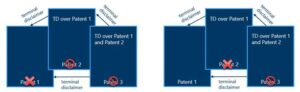
Figure 1. Exemplary impact of proposed terminal disclaimer rule change. Under the proposed rule change, a patent owner must agree that if any claim of a reference patent is found invalid, then any patent tied to the reference patent through a terminal disclaimer is unenforceable.
The USPTO asserts several purported benefits that would result from the change, if implemented. Specifically, the USPTO claims that the rules would streamline and expedite patent disputes because competitors could focus on the validity of claims in a single patent rather than multiple patents, when an enforced patent is tied to other patents by terminal disclaimers. [Id. at 40440.] This could, in theory, eliminate the need to challenge multiple patents separately in litigation or administrative proceedings and lower the financial burden associated with disputes. The USPTO claims that this change could not only reduce barriers to market entry, but could benefit consumers with increased competition. [Id.] The USPTO also highlights that the proposed rules change could potentially reduce the number of patents with only minor claim variations that are issued to a patent owner. [Id.]
Acknowledging that some applicants may be concerned about the ramifications of the proposed rule change, the USPTO proposed several strategies for addressing non-statutory double patenting rejections in a way that avoids the need for a terminal disclaimer. Specifically, the USPTO highlights the following four strategies:
[Id. at 40444.]
Additionally, the USPTO notes that if claims are amended after filing a terminal disclaimer in a way that obviates the basis for the double patenting rejection, a petition to withdraw the terminal disclaimer may be filed prior to issuance of the patent. [Id.]
While the proposed rule highlights purported benefits and efficiencies that the proposed changes would bring, there are many considerations that are not necessarily discussed or addressed by the proposed rule change.
Although the USPTO touts the purported benefit of streamlining and consolidation of patent disputes, litigation is already conducted on a claim-by-claim basis, in which the only claims from a patent owner’s portfolio that are asserted and adjudicated are the ones that relate to a particular act of infringement. Thus, the ripple effect associated with a finding of unpatentability or invalidity for a patent that is the subject of a terminal disclaimer could be drastic and significantly limit a patent owner’s ability to assert different claims against other potential infringers. Currently, a finding of unpatentability or invalidity of a claim in a patent does not necessarily speak to the validity of other claims in the same patent, let alone another patent. Extending the consequences of a finding of unpatentability or invalidity to all claims of a different patent whose claims are not challenged is a drastic change. This change would be a significant benefit to potential infringers who could theoretically invalidate multiple patents with a single challenge. Whether these changes would promote innovation and competition is up for debate. While they potentially could, the USPTO cites to no evidence that implementing the proposed rule would simplify avenues for invalidating patents and limit the ability to obtain patents on minor variants thereby bringing more competitors to the market, encouraging competitors to continue to innovate, or ‘leveling the playing field’ in a given marketplace.
As written, the rule appears to be prospective only. If the rule becomes final, there are significant questions with respect to patent families with more extensive histories. For example, a terminal disclaimer filed in a great grandchild application after the rule change could potentially have a broader effect on the entire family, even though the parent applications were not subject to the rule and were not drafted or prosecuted with the proposed rules in mind. The proposed rules do not appear to address how scenarios like this would be handled, and the potential retroactive effects that could significantly impact patent families that have existed since long before the rules were implemented.
Further, if adopted, applicants seeking to avoid filing a terminal disclaimer by filing omnibus patents may see increased costs and complexity associated with the preparation and prosecution of those patents. Significant care would be needed during the drafting process to ensure that all inventions are captured, and that the application and claims are drafted in such a way to invite restriction requirements, so that continuing applications could avail themselves of the safe harbor protection against obviousness-type double patenting rejections provided in 35 U.S.C. § 121.
Questions also remain regarding the procedural mechanisms associated with the proposed rule change. If an applicant seeks to obviate a non-statutory double patenting rejection with a terminal disclaimer, but fails to include the statement, how is this addressed procedurally? Does the applicant file a petition for entry of the terminal disclaimer, or must they take the case on appeal? These and other procedural questions remain and should be addressed by the USPTO.
Lastly, starting in October 2024, the USPTO will be implementing a tiered fee schedule for terminal disclaimers where fees vary depending on the stage of prosecution in which a terminal disclaimer is filed. The proposed rule change does not indicate how the new fee schedule would, if at all, be impacted by the proposed rule. 89 FR 23248-50.
The period for public comment on the proposed rules ends 9 July 2024. As of 7 June 2024, 28 comments have been received. While the final outcome of the proposed rule change remains to be seen, the proposed change is a polarizing one that has many questioning the benefits of the change, as well as the USPTO’s rulemaking authority to effect such a change.
Jameson Gardner (Ph.D.) is an associate in the Reston, VA office of Finnegan, Henderson, Farabow, Garrett & Dunner, LLP (‘Finnegan’) and Amanda Murphy (Ph.D.) is a partner in Finnegan’s London office. The opinions expressed are those of the authors and do not necessarily reflect the views of their firm, its clients, or any of its or their respective affiliates. This article is for general information purposes and is not intended to be and should not be taken as legal advice.
Jameson K. Gardner and Amanda K. Murphy
Lee Davies
Conor Wilman
Paul Cole
John Gray
Jameson K. Gardner and Amanda K. Murphy
Darren Smyth, Joanne Welch and Alona Andrieieva
Conor Wilman
Ian Mirandah, Melissa Wu
Paul Cole
Finnegan
Beck Greener LLP
David Pearce (Barker Brettell LLP)
Bristows
Darren Smyth, Isabelle Schaller, Joanne Welch, Catherine Howell
CIPA update
Lucie Jones
Annemarie Parsons
Rebecca Caulton
Annemarie Parsons
Andrea Brewster
Bill Orr, Philip Archer and Michael Harrison
David Norris, Bill Orr, Christopher Gibbs and Michael Harrison
Iain Ross
Joel David Briscoe
PEB
PEB update
Congress 2024 update
Epseeta Chowdhury
Ashley Tambe
Epseeta Chowdhury
Becca Allen