Protective letters – the first line of defence against preliminary measures at the UPC
Sean Jauss and Matthew Naylor



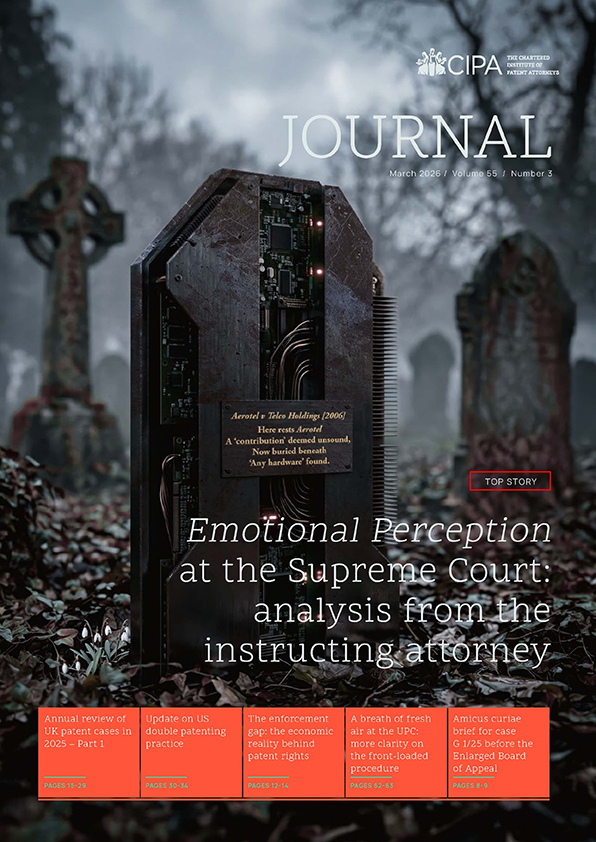
Following the Emotional Perception decision, did the IPO miss an opportunity to clarify its guidelines for examining AI and artificial neural network implemented inventions? And what takeaways can we learn from the July Appeal Decision which found in favour of the IPO?
This article was originally written a few weeks after the Appeal was heard as a blog article. I was torn at the time of writing it, as whilst I really wanted the IPO to become more favourable to patenting AI technology, I did not think the decision would survive the appeal. The Appeal decision was published on 19 July 2024, and found in favour of the IPO, and what you see below has now been updated to address this, with a short section at the end about the judgment itself.
I was quite looking forward to reading the UK Intellectual Property Office (‘IPO’) latest update to its guidelines for examining artificial intelligence (‘AI’) and artificial neural network (‘ANN’) implemented inventions. However, I couldn’t help but feel an opportunity to set out a best practice to clarify the law and reduce uncertainty for applicants in this area was muddled and missed yet again.
This probably was a deliberate ploy of course. The updates were published just before the IPO appeal to the Court of Appeal was heard to overturn an earlier High Court decision which found in favour of the applicant in Emotional Perception AI Ltd v Comptroller-General of Patents, Designs and Trade Marks [2023] EWHC 2948 (Ch). The High Court decision overturned a decision by an IPO hearing officer to refuse a patent application on the basis the AI-related invention was nothing more than a computer program per se and so formed unpatentable subject matter. The Emotional Perception decision which was handed down by the High Court on 21 November 2023 led to a fundamental revision of the IPO practice as examiners were no longer able to treat ANN inventions as excluded subject matter under the computer program per se objection. The IPO appealed the decision and with the Court of Appeal hearing scheduled for 14 May 2024 only a few days after the May 2024 guidelines update was published, I couldn’t help but wonder if this was a pragmatic update by the IPO in view of their expectations of the likely outcome of the appeal. It seems to have been as the Appeal judgment handed down later on 19 July 2024, found in favour of the IPO on all four grounds of appeal.
I am a UK and European patent attorney who has handled many computer-implemented inventions including AI and machine learning (‘ML’) technology over the years. When I wrote this article originally, I didn’t want to speculate on the outcome of the appeal although I hoped it would improve the situation for all UK inventors who are generating AI or ML-based inventions.
The UK is likely to increasingly rely upon innovative AI and ML technology to boost our economic recovery. Currently, I can’t but feel here in the UK we are at a disadvantage compared to elsewhere in Europe where national patent offices more closely follow the European Patent Office (‘EPO’) approach to patent examination of computer-implemented technology. The patent offices in Sweden, Denmark (and even Luxembourg) are some examples of national patent offices which do excellent search and examinations which are more like the EPO in their analysis for a very reasonable cost. Of course, whilst these national offices can be used by UK start-ups and SMEs as an alternative to the IPO, it may not always be a suitable approach and, frankly, we should have our own national route available for small inventors and start-ups to follow if they can’t afford the far higher cost of filing for patent protection before the EPO. The EPO still is, in my opinion, the favoured route for obtaining patent protection in the UK for many forms of computer-implemented invention simply because the EPO approach for assessing patentable subject matter is more predictable for inventions involving AI and now the Court of Appeal has issued its decision this remains the case.
So, coming back to the UK situation, the High Court decision essentially determined that a (trained) emulated ANN was more than a computer program as such, which means that the IPO route could have been more favourable even than the EPO if this continued to be the way the IPO examine AI and ML inventions.
The HC judgment considered in depth a lot of nuances regarding what is meant by a computer and a computer program. Now I favour the definition of a computer program as a set of instructions which are devised by a (originally only human) programmer which, when executed by a computer, cause a number of operations to be performed on operands (data). Based on a similar definition, and somewhat paraphrasing the actual decision, an ANN was found to be more than just a computer program and the trained ANN was distinguished from the computer program which was used in training and executed on a computer to implement the ANN. It was considered irrelevant whether the ANN was an emulation of a hardware implemented ANN.
Now, I agree that a trained ANN may be considered more than a computer program per se, if, for example, you consider that originally the term computer program related to a set of written instructions which were executable by a computer, and so protectable by copyright. However, for many reasons, one of which is I am aware that many ANNs are initially trained and then subjected to on-going training, I was somewhat wary of getting too excited and relying on this pre-appeal decision to favour the UK route to patentability for AI and ML in all its shapes and forms.
At the time, I found both the IPO practice guidelines originally published and the later practice updates disappointing because I felt the IPO had in some places summarised the reasoning set out in the judgment in a manner which arguably meant it lost some of the nuances essential for the HC decision to make some sense. Perhaps this was a pragmatic approach given that an appeal had been lodged, but I felt an opportunity was missed here.
My disappointment was increased by the May 2024 revised scenarios which accompanied the last update to the guidelines. It was a shame that the IPO did not take the time to provide more reasoning about why these scenarios were suddenly no longer excluded subject matter, but given the pending appeal, it was not surprising. Example scenarios 13, 14, and 15 were revised from being excluded to non-excluded subject matter but the commentary by the IPO was particularly terse. All three scenarios which were affected related to core AI examples and the guidance given is along the lines of:
‘Ask whether the contribution falls solely within the excluded subject matter; and check it is actually technical in nature – Following the judgment in Emotional Perception,[1] an invention involving an artificial neural network (ANN), whether implemented in hardware or software, is not a computer program as such. No other exclusion applies.’
The conclusion given is then stated as: ‘The invention defined in the claim is not excluded under section 1(2) as a program for a computer as such.’
Useful to know, but not really as helpful as these scenarios could have been. Of course, since the Appeal judgment found in favour of the IPO – you can now simply delete the commentary they added, and these examples will revert back to being examples of subject matter which IS now excluded.
As for the updated guidelines that came out in May 2024, well I’ll set out below some of the comments it includes on Emotional Perception and the actual judgment. Firstly, let’s take a look at the sections 126 to 131 of the updated guidelines on hardware-implemented AI where we see: ‘126. An AI invention may be claimed in hardware-only form which does not rely on a program or a programmable device in any way’.
Later in paragraph 128: ‘However, in Emotional Perception, the court held an ANN, whether implemented in hardware or software, is not a computer program.’ This conclusion given in paragraph 131 is: ‘An AI invention likely reveals a technical contribution if claimed in a hardware-only form which does not involve a computer program or a programmable device.’
Note, however, that there is no limitation to ‘a computer program as such’, etc in the conclusions here which in my opinion fails to fully take into account Emotional Perception as it gives the impression that drafting claims which recite an ANN implemented in hardware in a way that avoids any reference to programming is the way to go for the claim to be regarded as patent-eligible subject matter. In fact, post Emotional Perception as handed down by the HC, this was not the only route, at the time these guidelines were revised before the outcome of their appeal.
Elsewhere in the revised IPO guidelines section on Emotional Perception, I couldn’t help but feel the references to passages in the judgment made by the IPO fail to fully convey the reasoning given for the decision, for example, in the guidelines in paragraphs 35 to 37 we have:
‘35. The judgment noted that an ANN may be implemented, for example as a physical box with electronics in it (see paragraph 14). Alternatively, an ANN may be implemented using a piece of software which enables a conventional computer to emulate the hardware ANN (see paragraph 18). The judgment considered both the hardware and software implementations and concluded that while both involve a computer, neither involves a computer program. Accordingly, the court held as a matter of construction the claimed invention was not a computer program at all (see paragraph 61). The computer program exclusion was not invoked by the claimed invention.
The actual judgment in Emotional Perception mentions in paragraphs 76 to 78:
‘76. … The Hearing Officer seemed to consider that a subjective appreciation of the output of the system was just that, subjective and in the user, and therefore not a technical effect. I do not consider that to be the correct analysis. The Hearing Officer was right to acknowledge that the result of the invention was an effect external to the computer in the transmission of a chosen file. That is usefully analogous to the file that was moved in the third Gemstar patent. The correct view of what happened, for these purposes, is that a file has been identified, and then moved, because it fulfilled certain criteria. True it is that those criteria are not technical criteria in the sense that they can be described in purely technical terms, but they are criteria nonetheless, and the ANN has certainly gone about its analysis and selection in a technical way. It is not just any old file; it is a file identified as being semantically similar by the application of technical criteria which the system has worked out for itself. So, the output is of a file that would not otherwise be selected. That seems to me to be a technical effect outside the computer for these purposes, and when coupled with the purpose and method of selection it fulfils the requirement of technical effect in order to escape the exclusion. I do not see why the possible subjective effect within a user’s own non-artificial neural network should disqualify it for these purposes…
I personally interpret the latter paragraph as implying that training activity which causes an ANN model to evolve from an initial state over time to a different (trained) state may provide an external technical effect as it causes a trained ANN data processor (which may be configured in hardware or emulated in software) to come into existence. In my opinion, the May 2024 revised IPO guidelines did not sufficiently address these subtleties or how a technical effect may be being provided which may remove the computer program as such subject matter exclusion.
I remain hopeful now that the Appeal judgment is handed down, we will gain more clarity as case law continues to evolve. There is a subtly which I can’t help but wish the IPO guidelines had addressed and it’s a shame we will have to wait for another case to have this hopefully addressed.
Before the appeal decision was published, my recommendations were to proceed cautiously before the IPO, as there was clearly some reluctance to follow the HC decision which found in favour of Emotional Perception. As the appeal by the IPO was successful, UK examiners are likely now to receive guidance to revert back to their practice of applying the usual tests for patentable subject matter to computer-implemented inventions, even if an ANN is recited in the main claims, and I suspect this may happen very soon.
So, now the appeal by the IPO has been won, we are back to facing a more challenging regime for patenting core AI and AGI inventions in the UK. If you are considering patenting AI inventions, my suggestion is that you file either with the EPO or with another national patent office which more closely follows the EPO practice for searching as this way so you may be more likely to obtain a search. If, however, if you are confident your invention as claimed is not excluded-subject matter, then the IPO will remain likely to be the cheapest initial route.
Wherever you decide to file, drafting AI can be quite challenging. So here are some tips for drafting, which are mostly likely to be useful if you are considering seeking patent protection before the EPO or elsewhere, for core or applied AI inventions:
Of course, there are various diverse types of training, including supervised and unsupervised, and even once trained initially, some ANNs are configured to be retrained to learn in their operational phase. So, for each of the training and operational modes of an ANN where the AI model is arguably contributing to the invention, consider if it may be beneficial to clearly differentiate, where possible, the effect of the processes performed within the ANN which occur during training from those which may manifest in the ANN in its trained state, and how these result in different ANN behaviours affecting what the ANN outputs. It may also be useful in some situations to explain, if different types of training are possible, what impact they have on the resulting trained ANN. If the ANN is capable of being partially or fully implemented in hardware, then this should also be indicated in the description of the invention and possibly reflected in the claims.
Of course, there are also other factors to bear in mind when drafting AI inventions such as sufficiency of disclosure as mentioned above, but more detail on that is out of scope here and the EPO guidelines give some particularly useful guidance for this.
Computer-implemented invention drafting can be daunting for anyone who does not often handle this area of technology and drafting patents for AI-related inventions technology can be particularly challenging for various reasons. At the end of the day, consistent case law and a climate at the IPO favouring searching AI and ML-based inventions would be very helpful for applicants and their professional representatives as they prepare to navigate the pitfalls they could face when seeking patent protection for innovative AI and ML technology.
The Appeal decision in the matter of Comptroller – General of Patents, Designs and Trade Marks and Emotional Perception AI Limited [2024] EWCA Civ 825, is available for download from the Judiciary web-site[2] where you can also find links see the actual appeal court hearing (if you have a few days spare to view it).
There is not sufficient time before we go to press to present a fully detailed analysis, so I leave that to one of the representatives involved in the case to comment on later.* Briefly, though, the IPO Comptroller appealed successfully on all four of the following grounds:
The judgment sets out the issues well and is not too long to read (if you are patent attorney I really recommend it). Those who are familiar with the case may want to start with paragraphs 75 to 86. In the judgment, subject only to the step of sending a recommended file to a user, the whole remainder of the contribution made by the invention (where the contribution referred to here is the contribution for inventiveness based on the UK’s approach to assessing inventive step under Aerotel Ltd v Telco Holding Ltd [2007]), was considered to consist of a program for a computer.
The function of the computer program was considered to provide improved file recommendations. The correct characterisation of the function of the computer was stressed as being critical to determining patentability along with whether the hearing officer was right to find the subject matter exclusion applied, because the beneficial effect the file recommendation was of a subjective and cognitive nature, or whether the HC Judge was right to hold that the exclusion did not apply, because even though what made the file recommendation better was not technical criteria (because the semantic similarity is a subjective matter), the ANN had reached that result by “going about its analysis and selection in a technical way”.
The appeal found the semantic similarly of the files was found to what led to them being recommended, which was found to not be technical. The fact that there was an external transfer of data (the file recommendation) did not help for the same reason. “What matters is the correct characterisation of the data being transferred…”
A fundamental takeaway from this judgment in my opinion, is that it stresses correctly characterising the function of a computer program may be critical in terms of whether it is making a technical contribution or not, which may ultimately affect its patentability.
Dr Coreena Brinck (Fellow) is a UK and European patent attorney, a consultant at Two-IP: [email protected] and also works part-time as Head of IP, for IntuiCell AB, a Swedish start-up which is developing a new form of artificial general intelligence.
* In the September 2024 issue there will be an update from Bruce C. Dearling (Fellow) of Hepworth Browne Ltd who represents Emotional Perception AI.
[1] https://www.bailii.org/ew/cases/EWHC/Ch/2023/2948.html
[2] https://www.judiciary.uk/wp-content/uploads/2024/07/Comptroller-General-of-Patents-Designs-and-Trade-Marks-v-Emotional-Perception-AI.pdf
Sean Jauss and Matthew Naylor
Conor Wilman
Coreena Brinck
Rose Hughes
Lee Davies
Lee Davies
Keith Loven
CIPA consultation response
IPO Update
IPO update
IPO update
Daniel Wise, Fergus Tyrrell
Fergus Tyrrell
Hannah Brown, Adam Ellwood, Paul Kaufman
Rhodri Hopes , David Holland
Oliver Williams, Paul Kaufman
Rose Hughes
Conor Wilman
Sean Jauss and Matthew Naylor
Coreena Brinck
Finnegan
Beck Greener
David Pearce
Bristows
EIP
Khushbu Solanki
Bird & Bird
Patent Examination Board
Informals Committee
Lucie Jones
Annemarie Parsons
David Jones
Andrea Brewster
CIPA