A revamp for EU design law
Arjun Grewal, Hugh Dunlop



Campbell Forsyth, sitting as Deputy Judge of the High Court, recently handed down judgment in WaterRower v Liking,[1] a decision many practitioners had been waiting for since the judgment in the strike-out hearing in IPEC in July 2022 that the WaterRower machine was arguably a ‘work of artistic craftsmanship’ and should be allowed to go to trial.
As such, there was an expectation that the breadth of the category of works of artistic craftsmanship could be broadened, and more industrial designs might be entitled to protection as copyright works (in addition to protection by unregistered designs and potentially registered designs and patents).
The case related to water resistance rowing machines including the prototype, illustrated, and various modifications thereof, namely versions 1-8, designed by Mr John Duke, a keen rower.
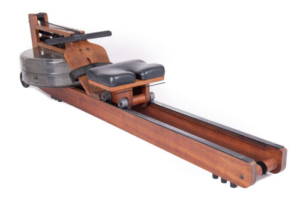
The prototype WaterRower machine
WaterRower Ltd (‘WaterRower’) asserted that copyright protection under section 4(1)(c) CDPA[2] subsisted in the Works as ‘works of artistic craftsmanship’. The defendant, Liking Limited (‘Liking’), was said to have copied the Works by reproducing a substantial part in their TOPIOM machines, thereby infringing WaterRower’s copyright in the Works.
Liking accepted that the Works had been copied, but alleged that no copyright subsists in the Works as they are not ‘works of artistic craftsmanship’.
Both parties acknowledged the ‘particularly difficult tension’ between the UK’s approach to the meaning of the term ‘work of artistic craftsmanship’ and EU law. In particular, the High Court are bound by the findings in the 1976 House of Lords decision in Hensher[3] which require a work to have ‘more than eye appeal’ whereas leading EU case law, namely Cofemel[4] and Brompton,[5] require no consideration of artistic merit in assessing whether a work is entitled to be protected.
Judge Campbell Forsyth concluded that no copyright subsists in any of the Works as ‘works of artistic craftsmanship’ and as such, there was no infringement by Liking. However, the journey to reaching this assessment touched on several interesting points of law.
Notably, WaterRower only pleaded that the Works were ‘works of artistic craftsmanship’, and therefore fall within the definition of artistic works set out in section 4(1) CDPA 1988[6] such that copyright subsists. There remains an open question, untested by the courts, as to whether the tension could be overcome by acknowledging a category of works outside the list of section 4(1) CDPA, i.e. copyright works as defined more broadly by retained EU law.
The decision provides a detailed synopsis of the legislative background, with extensive quotations from textbooks, making it a very readable refresher on the law in relation to ‘applied art’ and the overlap with design rights[7].
Key aspects included whether the UK’s ‘closed category’ approach to works which may attract copyright protection as artistic works under section 4(1) CDPA conflicts with European law.
The InfoSoc Directive[8] attempted to harmonise certain aspects of copyright law and is the source of tension with UK law. In particular, article 2 of the InfoSoc Directive reads:
‘Member States shall provide for the exclusive right to authorise or prohibit direct or indirect, temporary or permanent reproduction by any means and in any form, in whole or in part:
(a) for authors, of their works;
…’
This terminology placing no limitation on what works of authors should be protected, led to the decisions of Cofemel and Brompton, discussed in greater detail below.
Following the UK’s withdrawal from the EU, any law which transposed an EU directive prior to 31 December 2020 remains binding on UK courts[9], subject to any appeal or amendment.
Consequently, the Judge determined[10] that the rule of supremacy of EU law applied to the CDPA so the decisions of the CJEU in Cofemel and Brompton must be considered in relation to the court’s treatment of ‘applied art’ under section 4(1)(c) CDPA.
Section 1(1) CDPA[11] provides that copyright subsists in ‘original literary, dramatic, musical or artistic works’. The various categories of artistic works include at section 4(1)(c) CDPA ‘a work of artistic craftsmanship’.
As there is no statutory definition of a ‘work of artistic craftsmanship’, the leading case on the meaning of section 4(1)(c) CDPA is the House of Lords case Hensher.
In Hensher, their Lordships considered the meaning of ‘a work of artistic craftsmanship’ on the understanding that the work in question, an item of prototype furniture, was accepted by both parties to be a work of craftsmanship. Accordingly, only the meaning of ‘artistic’ was disputed.[12] The House of Lords unanimously found the prototype furniture was not a ‘work of artistic craftsmanship’.
Each of their Lordships provided an opinion on interpretation of ‘a work of artistic craftsmanship’. It was clear that the court’s assessment of the artistic quality of a work should be avoided. According to Lord Reid ‘Judges have to be experts in the use of the English language, but they are not experts in art or aesthetics.’
However, there is less consistency in the Lord’s speeches as to how the phrase should actually be interpreted. In general, on Campbell Forsyth’s interpretation,[13] it seems that something ‘more than eye appeal’ is required for a work to qualify. Furthermore, the context of the creation[14] and the intention of the author[15] is important when making the assessment. Using the example of a woodworker, perhaps relevant in this case given WaterRower’s use of wooden frames, Lord Simon noted ‘some of their work would be generally accepted as artistic craftsmanship, most not.’[16]
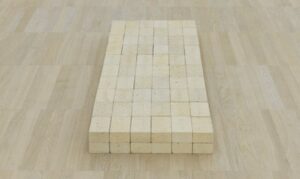
Carl Andre, Equivalent VIII, 1966, 120 Firebricks, 5 in × 27 in × 90+1⁄4 in (130 mm × 690 mm × 2,290 mm). Image courtesy of the Tate.
Liking’s counsel noted the importance of context in the assessment of what is artistic by comparing two identical piles of bricks, presented in the Turbine Hall of the Tate Modern Gallery and on a construction site respectively.[17] The point of the analogy was to highlight the relevance of the craftsman’s intention to create a work of artistic craftsmanship.
Another leading authority, albeit only from IPEC, is the decision of HHJ Hacon in Response[18] in which HHJ Hacon noted the difficulty in identifying the ratio in Hensher. The case considered whether copyright subsisted in a wave design woven into fabric.
In Response, the Judge concluded that the wave fabric would not have constituted a ‘work of artistic craftsmanship’ under any of the Lord’s analyses in Hensher. However, when assessed based on the interpretation of a New Zealand High Court in Bonz,[19] the HHJ Hacon concluded that the requirements of section 4(1)(c) CDPA were met. Thus, the definition of a ‘work of artistic craftsmanship’ was stretched significantly compared to what many practitioners may have learned in their training.
Nevertheless, HHJ Hacon noted that there were significant issues of conformity with EU and UK law such that:
‘Complete conformity with art.2, [article 2 of Directive 2001/29/EC of 22 May 2001] in particular as interpreted by the CJEU in Cofemel, would exclude any requirement that the Wave Fabric has aesthetic appeal and thus would be inconsistent with the definition of work of artistic craftsmanship in Bonz Group.’
Indeed, HHJ Hacon granted leave to appeal, but unfortunately the appeal was not pursued as the appellant fell into administration.
Given the differing approaches outlined above, the decision[20] notes the difficulty in attempting to further define how the court should approach the assessment of ‘works of artistic craftsmanship’.
Helpfully, Campbell Forsyth attempted to ‘draw together’ the key principles from Hensher and the other relevant UK authorities to help determine how a ‘work of artistic craftsmanship’ should be construed[21]:
The court is also bound by CJEU decisions which interpret the InfoSoc Directive as implemented by the CDPA in the UK.
Following a series of decisions of the CJEU on copyright protection under article 2(a) of the InfoSoc Directive, Cofemel considered the copyright protection of various items of clothing including G-Star’s ARC jeans and ROWDY t-shirt designs. The case defined the two requirements for something to be considered a work as:
‘First, that concept entails that there exist an original subject matter, in the sense of being the author’s own intellectual creation. Second, classification as a work is reserved to the elements that are the expression of such creation…’
To satisfy the first originality condition, the subject matter must reflect ‘the personality of its author, as an expression of his free and creative choices’.
In relation to the second condition, the CJEU in Cofemel advised that despite the appearance of a potential work creating an ‘aesthetic effect’, this effect ‘… does not, in itself, make it possible to determine whether that design constitutes an intellectual creation reflecting the freedom of choice and personality of its author…’.
Within the meaning of the InfoSoc Directive, the courts in Cofemel interpreted ‘works’ as
‘… precluding national legislation from conferring protection, under copyright to designs such as the clothing designs at issue in the main proceedings, on the ground that, over and above their practical purpose, they generate a specific, aesthetically significant visual effect.’
Therefore, so long as the work is original, there is no requirement for aesthetic effect.[22]
Following on from Cofemel, Brompton confirmed that it is not possible to obtain copyright protection for a work solely dictated by technical function. However, in instances where the technical considerations have ‘not prevented the author from reflecting his personality in that subject matter, as an expression of free and creative choices’ the product can still enjoy copyright protection.
According to the principle set out in Marleasing,[23] domestic legislation must be construed ‘as far as possible in conformity with, and to achieve the result intended by, the directive’. However, as noted by Liking, ‘as far as possible’ does not permit the meaning of the domestic legislation to be distorted.[24] In line with this view, Liking did not believe that it was possible to reconcile the decisions in Cofemel and Hensher and ultimately the Judge agreed.
The decision found that the prototype was an original work within the meaning of the InfoSoc Directive, but that it was not entitled to copyright protection under section 4(1)(c) CDPA on the application of Hensher. [25] The decision went on to address the inconsistency between the UK and EU position as noted in Response.
Despite there being similarities between the UK and EU position, it was found that it is impossible to reconcile the two.[26] In explanation, the decision acknowledged that although the standard of originality required by both Cofemel and the relevant sections of the CDPA other than section 4(1)(c) harmonises copyright protection, the harmonisation cannot stretch to require artistry in craftsmanship without distorting the intention of Parliament.
Therefore, section 4(1)(c) cannot be reconciled with the InfoSoc Directive. Despite this conclusion, to address the issues in this case, section 4(1)(c) could still be applied along with Hensher and the relevant UK authorities[27] alongside the InfoSoc Directive.
Following HHJ Hacon’s consideration of the Wave Fabric in Response, ‘If it was not original, copyright does not subsist anyway and the meaning of ‘artistic craftsmanship’ is academic’, the judge decided that to partially conform the EU and UK laws, when applying section 4(1)(c) CDPA, it should first be determined whether the work is original in line with the InfoSoc Directive. In other words, this initial assessment acts as a ‘form of gateway’.[28] Only if the work is considered original is it necessary to consider the application of ‘work of artistic craftsmanship’ under section 4(1)(c) CDPA in line with the relevant UK authorities.
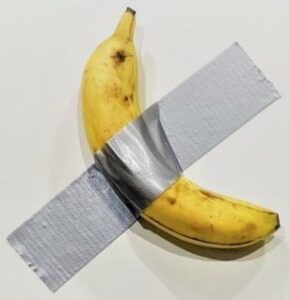
Comedian is a 2019 artwork by Italian artist Maurizio Cattelan.
It was accepted that the prototype was the first relevant completed article.[29] It was also accepted that certain aspects of the prototype must allow the rowing machine to function as such. For example, the shape must allow for human movement, so requires a rolling seat system and handle.
The concept of the prototype is the subject of a long since expired US Patent.[30] Despite Liking’s argument that the US Patent discloses how Mr Duke arrived at the shape and features of the prototype, the Judge noted that the technical constraints disclosed in the US Patent mostly relate to the sealed tank and motion of the paddle. In creating the prototype, Mr Duke made several design choices in a bid to create a rowing machine which re-created the experience of rowing on water.
In light of this, the prototype was deemed original under the InfoSoc Directive as the design was Mr Duke’s own intellectual creation.[31]
The modifications to the prototype, namely versions 1-8, were generally considered to improve ‘manufacturability, efficient assembly and supply issues’.[32] None of the modified versions were considered original works as intended in Cofemel, Brompton, or under the InfoSoc Directive.
As the prototype was considered the only original work, it was necessary to assess whether the prototype would also satisfy the requirements of a ‘work of artistic craftsmanship’.
It was acknowledged that Mr Duke’s evidence ‘demonstrated significant effort and skill in the creation of the early development of prototype’, such as the choice of materials, the shape of the frame, and the hand finishing. [33] However, there were also several technical constraints such as the requirement for a rolling seat and the dimensions to be suitable for a human.
It was also acknowledged that ‘a significant section of the public found the WaterRower design aesthetically pleasing’.[34] Giving weight to this argument is the fact the WaterRower product has been sold in the Museum of Modern Art’s Design Store in New York where it is described as ‘a sculptural piece of exercise equipment’ which looks ‘elegant and artful when stored’.
Yet despite this, the decision also notes that the prototype was a commercial development, leading the Judge to reject Mr Duke’s evidence that his intention ‘was to create a work that went further, one where the craftsmanship in its creation was artistic’.[35]
It was noted that although Mr Duke may be considered a craftsman, when creating the prototype, he did not exhibit the character of an artist craftsman,[36] thus answering Lord Simon’s point in Hensher: ‘It is therefore misleading to ask, first, is this a work produced by a craftsman, and secondly, is it a work of art? It is more pertinent to ask, is this the work of one who was in this respect an artist-craftsman?’
In the absence of a binding decision to the contrary, the Judge concluded that there was nothing preventing him from taking a multi-factorial approach[37] and assessing all relevant factors including the expert evidence, the views of relevant parts of the public, and the author’s intention when construing whether the Works fall within the definition of a ‘work of artistic craftsmanship’. Based upon such an assessment, i.e. giving the term ‘work of artistic craftsmanship’ its ‘ordinary and natural meaning’, and considering the multi-factorial nature of the evidence, it was decided the prototype was not a ‘work of artistic craftsmanship’ under section 4(1)(c) CDPA.[38]
Overall, the decision is likely to be welcomed by those who consider that works of industrial handicraft are adequately protected by unregistered designs and registered designs/patents where applicable, with their relatively short term. Of course, it will be a blow to designers hoping to extract some form of protection when such rights expire, who will have seen Response as a movement of the legal landscape in their favour.
The decision may be looked at as a triumph for sovereignty and the application of UK law, and a return to the status quo, although it is important to note that EU law has been applied, just perhaps as a bit of a fudge.
Indeed, the approach of applying InfoSoc only as a gateway to assessment of whether a work is one of artistic craftsmanship in accordance with the CDPA does not give the impression of the supremacy of EU law precluding the assessment of artistic quality. It will certainly be interesting to see whether the case is appealed, as the Court of Appeal would not be obliged to apply EU derived law, and could do away with any attempt at conformity.
It is also interesting to speculate as to why WaterRower did not argue that in the event that the work was not considered one of artistic craftsmanship, it was a copyright work outside the closed categories of section 4 CDPA, but nonetheless a work in accordance with Cofemel which must be protected in accordance with the supremacy of EU Law. Perhaps they felt such an argument would be given short shrift; perhaps an oversight; or perhaps it was felt that the weight of evidence as to the aesthetic quality of the product as compared to most gym equipment, meant they expected to succeed.
When it comes to assessing whether a work is one of artistic craftsmanship, it seems that, albeit with the assistance of experts, UK judges will still be facing the vexed question of ‘what is artistic?’. A banana and some duct tape?![39]
Sarah Doyle (Student) is a trainee patent attorney at Wilson Gunn. Mark Jolly (Fellow) is a partner at Wilson Gunn and member of CIPA’s Designs and Copyright Committee
[1] WaterRower v Liking [2024] EWHC 2806 (IPEC)
[2] Section 4(1)(c) Copyright, Designs and Patents Act 1988
[3] George Hensher Ltd v Restawile Upholstery (Lancs) Ltd [1976] AC 64
[4] C-683/17 Cofemel – Sociedade de Vestuário SA v G-Star Raw CV
[5] SI, Brompton Bicycle Ltd and another v Chedech/Get2Get (Case C-833/18) [2020] E.C.D.R. 9
[6] Section 4(1) Copyright, Designs and Patents Act 1988: ‘In this Part ‘artistic work’ means— (a) a graphic work, photograph, sculpture or collage, irrespective of artistic quality, (b) a work of architecture being a building or a model for a building, or (c) a work of artistic craftsmanship.’
[8] European Parliament and Council Directive 2001/29/EC
[9] Section 6, European Union (Withdrawal) Act 2018
[10] Paragraphs 78 and 79 of the decision
[11] Section 1(1), Copyright, Designs and Patents Act 1988: ‘Copyright is a property right which subsists in accordance with this Part in the following descriptions of work — (a)original literary, dramatic, musical or artistic works, (b) sound recordings, films or broadcasts, and (c) the typographical arrangement of published editions.’
[12] WaterRower v Liking [2024] EWHC 2806 (IPEC), paragraph 92
[13] Ibid. paragraph 110
[14] Ibid. paragraph 107
[15] Ibid. paragraph 112
[16] Ibid. paragraph 111
[17] Ibid. paragraph 132
[18] Response Clothing Limited v The Edinburgh Woollen Mill Limited [2020] EWHC 148 (IPEC)
[19] Bonz Group (Pty) Ltd v Cooke [1994] 3 NZLR 216 (‘Bonz’) was a case relating to woollen sweaters. Despite being heard by the New Zealand High Court, the relevant provision in the New Zealand statute was identical to that in the UK statute. In Bonz, Tipping J agreed with Hensher, that a work must have ‘some artistic quality’ and suggested:
‘… [F]or a work to be regarded as one of artistic craftsmanship it must be possible fairly to say that the author was both a craftsman and an artist. A craftsman is a person who makes something in a skilful way and takes justified pride in their workmanship. An artist is a person with creative ability who produces something which has aesthetic appeal.’ (‘the Bonz Test’)
[20] WaterRower v Liking [2024] EWHC 2806 (IPEC), paragraph 133
[21] Ibid. paragraph 135
[22] As a point of interest, when applying Cofemel, the Portuguese Supreme Court who referred the decision ruled that despite generating an aesthetic visual effect, there were insufficient grounds for originality of G-Star Raw’s designs. Consequently, it was ruled that the designs could not be protected by copyright and therefore, Cofemel did not infringe. As such, the standard of ‘originality’ does not appear to be truly harmonised across Europe, but held to a higher standard outside the UK.
[23] Marleasing SA v La Comercial Internacional de Alimentacion SA (C-106/89) ECLI:EU:C:1990:395 [1990] ECR I-4135
[24] WaterRower v Liking [2024] EWHC 2806 (IPEC), paragraph 145
[25] Ibid. paragraph 152
[26] Ibid. paragraph 156
[27] Ibid. paragraph 158
[28] Ibid. paragraph 159
[29] Ibid. paragraph 160
[30] Ibid. paragraph 163
[31] Ibid. paragraph 168
[32] Ibid. paragraph 173
[33] Ibid. paragraph 179
[34] Ibid. paragraph 181
[35] Ibid. paragraph 182
[36] Ibid. paragraph 188
[37] Ibid. paragraph 184
[38] Ibid. paragraph 185
[39] ‘Comedian’ is a 2019 artwork by Italian artist Maurizio Cattelan which appears as a fresh banana affixed to a wall with duct tape. Number two of three editions was sold for $6.2 million in November 2024.
Arjun Grewal, Hugh Dunlop
William Burrell
Greg Corcoran, Richard Lawrence
Sarah Doyle, Mark Jolly
Matt Dixon
Lee Davies
Lee Davies, Chief Executive
Neil Lampert
Greg Corcoran, Richard Lawrence
Neil Lampert
Neil Lampert
Pauline Beck
Emma Sharman
Emily Jones
Bristows
Arjun Grewal, Hugh Dunlop
William Burrell
Sarah Doyle, Mark Jolly
Beck Greener LLP
David Pearce
EIP
Bristows
Bird & Bird
Annemarie Parsons
Chloe Hart
Dóra Máté
Epseeta Chowdhury, Ashley Tambe, Becca Allen