USPTO patent fee changes for 2025
Finnegan



European Union (‘EU’) pharmaceutical legislation known as the Clinical Trials Regulation entered into force on 31 January 2022.[1] It aims to ensure the EU offers an attractive and favourable environment for carrying out clinical research on a large scale, with high standards of public transparency and safety for clinical trial participants. Before the Regulation, clinical trial sponsors were required to submit separate applications to the national competent authorities and ethics committees in each country to obtain regulatory approval for conducting a clinical trial. The Regulation streamlines this process by allowing sponsors to submit a single online application through the Clinical Trials Information System (‘CTIS’), thereby enabling approval for running clinical trials across multiple European countries more efficiently.
The transparency rules, revised in June 2024, govern the publication of clinical trial information submitted via CTIS. These rules aim to balance transparency and the protection of personal data and commercially confidential information (‘CCI’). In this respect, the EMA considers that a piece of information can be considered CCI if it meets simultaneously the following two criteria: (1) not being in the public domain or publicly available and (2) its disclosure would undermine the legitimate economic interests or competitive position of the concerned entities, e.g. sponsor, marketing authorisation applicants/holders or service providers, unless there is an overriding public interest in the disclosure.[2][3] The mere fact that certain pieces of information are not publicly available does not automatically imply that the information can be classified as CCI. For example, information describing the compliance with regulatory and scientific guidelines and application of scientific knowledge available at the time of the trial lacks any innovative elements since it is ‘built upon logic and common sense in line with the content of publicly available documents’ and can therefore not be considered CCI.[4]
The EMA Guidance indicates that the following are examples of elements that may be considered CCI[5]:
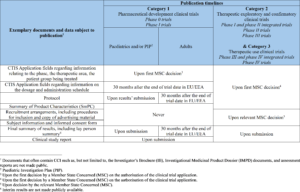
Examples of data and documents submitted to CTIS that are subject to publication are set out in the table below.[6] Disclosure timelines in accordance with the rules mainly depend on the trial category, the trial phase, and the trial population age. CTIS allows users to submit both a ‘for publication’ version and a ‘not for publication’ version of documents. This feature enables the redaction of personal data and CCI from the versions that are publicly published. It lies within the responsibility of the user to ensure that the version for publication does not contain such information.[7]
The structured data fields filled out on the CTIS application form, which include information on the trial title, study design, inclusion and exclusion criteria, primary and secondary endpoints, details on the investigational medicinal product, clinical investigator sites in the Member States where the trial is to be conducted, and the sponsor’s contact details, cannot be redacted. Therefore, for these fields consideration should be given to using ‘blank’ entries (e.g. 00 digits) for information that should be exempted from publication, since otherwise that data may be published. The full information should, however, be provided to the Member States for assessment in the document version ‘not for publication’.[8]
Other regulatory clinical trial disclosures
Of course, whilst we focus here on the recent changes on the publication of clinical trial information at the EMA, clinical trial publication in any jurisdiction will be relevant to a patent filing strategy. This is because there ‘are no restrictions whatever as to the geographical location where or the language or manner in which the relevant information was made available to the public’ for a disclosure to form part of the start of the art.[9]
Any disclosure concerning a drug and/or its therapeutic use will constitute prior art for a patent application related to the drug or therapy in question and therefore may be detrimental to a patent being granted. Therefore, in view of the regulatory requirements for publication of clinical trial related information, appropriate redaction of clinical trial documents as discussed above may be critical for existing and future patent applications. Additionally, the presence or absence of confidentiality agreements during a clinical trial, e.g. between the study sponsors and the patients taking part in the trial, can affect how much of the trial information becomes prior art for a patent application. As a result, effective communication amongst scientists, regulatory team members and patent counsels is essential to consider patent filing strategies.
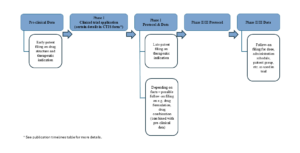
The challenge of determining the optimum time to file a patent application is a balance between filing before clinical trial documents are published, as these documents could become prior art[10] against the application relevant for the assessment of novelty and inventive step, and providing sufficient data in the application to meet disclosure requirements. In the context of a medical use claim, if a therapeutic application is to be accepted as sufficiently disclosed, the application and/or the common general knowledge has to provide some information rendering it ‘technically plausible for the skilled person that the claimed compounds can be applied for the claimed therapeutic use’.[11] Applicants therefore must consider both the risk of additional publications being added to the state of the art when filing late and the risk of insufficiency of their own invention when filing early.
As explained above, the phase of a clinical trial will determine its category with regard to the CTIS disclosure timelines. Of course, the relevance of clinical trial related disclosures will depend on the information already in the public domain regarding the subject matter of interest, e.g. the drug and/or therapy being investigated.
A phase 0 clinical trial is conducted to collect initial data on the behaviour of a new drug in the human body and to assess its potential harm, with no information regarding its possible therapeutic or prophylactic use. This type of trial generally involves a very small group of participants.
A phase I clinical trial typically is the first time a new treatment is tested in humans, and focuses on the drug’s pharmacokinetics (its behaviour within the human body) and pharmacodynamics (its effects on the body). A phase I study may also explore drug interaction evaluations or food effect studies that examine how eating affects drug absorption. Phase I studies are often conducted in healthy volunteers but can sometimes be conducted in patients.
Thus, phase I data may support a medical use claim, for example regarding the formulation of a drug, whether it is combined with one or more other drugs, but also the dosage of the drug, the administration schedule, the route of administration, and sometimes the patient group being treated. However, due to its exploratory nature, phase 0 data is unlikely to support a medical use claim.
A phase II clinical trial primarily aims to evaluate a treatment’s effectiveness while also continuously monitoring its safety. A phase III clinical trial involves a larger cohort of patients with the goals of confirming treatment effectiveness, monitoring side effects, and comparing outcomes with standard treatments.
Accordingly, phase II and III data may support the therapeutic effect of a drug tested in the trial. Of course, at this point the therapeutic use may be known in the art in view of preclinical and/or phase I data, and therefore the patent claim is likely to be directed to a more ‘complex’ medical use, such as the dosage of the drug, the administration schedule, the route of administration, as well as the patient group being treated, but also the drug formulation and whether it is combined with one or more other drugs.
A first option is to file before a planned clinical trial is announced, and therefore for phase II and phase III trials before a clinical protocol is disclosed, such that the announcement of the clinical trial will not be prior art against the patent application. This strategy is suitable where it is sufficient to rely on, e.g. preclinical evidence (in vitro and/or in vivo in animal studies) that reflects the therapeutic application to comply with the sufficiency and inventive step requirements. In this case, post-published evidence such as clinical data may also be taken into account under certain conditions.
In this situation, although redacting clinical trial documents may not be necessary, it could still be beneficial to consider redaction to preserve potential future filings.
A second option is to file upon completion of the clinical trial so that the trial data can be included in the patent application. This situation is relevant where, e.g. preclinical data is unlikely to be enough to meet the requirements of sufficiency of disclosure and/or inventive step. This would also be relevant where, upon completion of the trial, unexpected results are obtained, such as a patient sub-population responding exceptionally well, which was not anticipated at the outset.
Therefore, measures should be put in place to minimise any disclosure during the clinical trial which may be detrimental to the patent application.[12] This would include appropriate redaction of clinical trial documents, establishment of appropriate confidentiality agreements, e.g. between the study sponsors and the patients taking part in the trial, as well as limiting other disclosures such as press releases, publications in scientific journals and conferences.
Conclusion
Clinical trial disclosures play an important role in patent filing strategies. As highlighted in this article, the disclosure timelines mandated by regulatory agencies such as the EMA can be largely predicted, thus aiding navigating around these. However, due to the unpredictability of trial outcomes, a cautious approach is to always ensure appropriate redaction of clinical trial documents, as well as the establishment of appropriate confidentiality agreements. It is important to also account for other forms of disclosures, such as press releases, publications in scientific journals, and conference presentations.
As the case law indicates, addressing prior art disclosures related to clinical studies can be challenging, and we examine this topic in our EPO Boards of Appeal case law review, focusing on novelty and inventive step. Consequently, it is evident that patent filing strategies must fully consider regulatory activities throughout the entire life cycle of a drug.
[1] Regulation (EU) No 536/2014 of the European Parliament and of the Council of 16 April 2014 on clinical trials on medicinal products for human use, and repealing Directive 2001/20/EC.
[2] EMA’s definition of CCI in EMA/212507/2021 Guidance document on how to approach the protection of personal data and commercially confidential information while using the Clinical Trials Information System (‘CTIS’) Version 2 (18 June 2024) in accordance with POLICY/0043 (EMA/729522/2016; 4 October 2018).
[3] Overriding public interest applies in exceptional circumstances only, e.g. in case of declared pandemic, public health emergency.
[4] EMA/212507/2021 Guidance document on how to approach the protection of personal data and commercially confidential information while using CTIS Version 2 (18 June 2024).
[5] EMA/212507/2021 Guidance document on how to approach the protection of personal data and commercially confidential information while using CTIS Version 2 (18 June 2024).
[6] EMA/194159/2023 Annex I: Guidance document on how to approach the protection of personal data and commercially confidential information while using CTIS (13 December 2024).
Of note, ‘historical trials’ submitted to CTIS before the 18 June 2024 are subject to specific publication rules designed to avoid unintended disclosure of confidential information contained in documents which could have been subject to deferrals under the previous transparency rules.
[7] EMA/194159/2023 Annex I: Guidance document on how to approach the protection of personal data and commercially confidential information while using CTIS (13 December 2024).
[8] EMA/898965/2022 Q&A on the protection of Commercially Confidential Information and Personal Data while using CTIS, Section 3.3.
[9] EPO Guidelines (March 2024), G-IV, 1; Article 54 (1) & (2) EPC.
[10] The state of the art comprises everything made available to the public by means of a written or oral description, by use, or in any other way, before the relevant priority/filing date of the European patent application.
[11] Case Law Book, 10th Edition, II.C.4.1 and I.C.7.2.2(a).
[12] The EPO Boards of Appeal case law supports the position that, where a clinical study is announced, there is a ‘reasonable expectation of success’ of achieving the therapy disclosed unless there is ‘prejudice or teaching away’ in the art which would have dissuaded the skilled person to put the clinical trial proposal into practice, as will be discussed in Part II of this article.
Finnegan
Olivia Nimmo, John Coldham
Greg Corcoran, Richard Lawrence
Nadège Beynon, Sophie Skidmore, Gabriela Staber
Bristows
Emily Harris
Lee Davies
Lee Davies
Bobby Mukherjee
Adrian Howes
IPO
Lee Davies
Neil Lampert
Bristows
Nadège Beynon, Sophie Skidmore, Gabriela Staber
Finnegan
Greg Corcoran, Richard Lawrence
Olivia Nimmo, John Coldham
Beck Greener LLP
Bristows
David Pearce
Bristows
EIP
Dehns
Bird & Bird
Vicky Maynard
Emily Harris
Emma Norris
Informals Committee
James Fish, Carolynne Ellis-Jones and Simon Wright
Krishna Raghavan, John Hull, Andy Spurr
Andrea Brewster