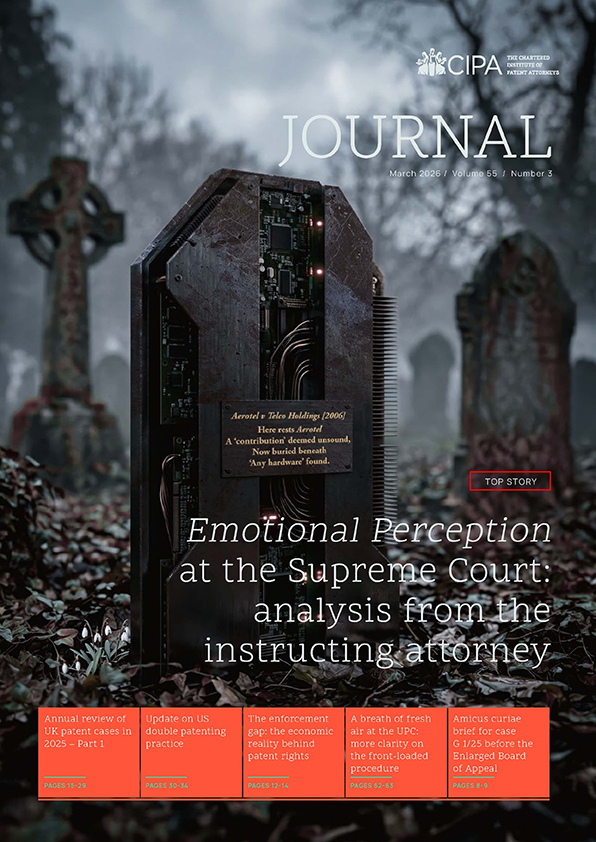
CIPA’s intervention in Emotional Perception
Caitlin Heard and Bobby Mukherjee,



1.1 These proceedings relate to the patentability of the Appellant’s Application GB1904713.3 (the ‘Application’) in the field of artificial intelligence systems (‘AIs’), and specifically Artificial Neural Networks (‘ANNs’).
1.2 The lower courts have handed down conflicting decisions on the patentability of the Application. In summary, the Intellectual Property Office (‘IPO’) refused the Application on the basis that the claimed invention was excluded under section 1(2) of the Patents Act 1977 (the ‘Act’) as a ‘program for a computer …as such’. The High Court reversed the IPO’s decision. The Court of Appeal then overturned the High Court decision. References to Emotional Perception herein are references to the judgment of the Court of Appeal in Comptroller-General of Patents, Designs and Trade Marks v Emotional Perception AI Ltd [2024] EWCA Civ 825.
2.1 The intervention concerns two important and interrelated issues which are of general public importance and fundamental to the assessment of patentability of computer-implemented inventions (CIIs)[1]:
2.2 The Interveners make no comment on the patentability of the claims of GB1904713.3.
2.3 The wider significance of the lower courts’ judgments in the present case is highlighted by the January 2025 revisions to the IPO’s Manual of Patent Practice and to the IPO’s published guidance ‘Examining patent applications relating to artificial intelligence (AI) inventions’. These texts were amended following the High Court decision and then amended again following the Court of Appeal decision.
2.4 The Court of Appeal judgment includes a very broad definition of ‘computer’ (to the extent of being inconsistent with industry usage) and then relies on this overly-broad definition to suggest that an ANN is a ‘machine for processing information’ and ‘clearly a computer’ (paragraph 68). This is technically incorrect. It is accompanied by a broad definition of ‘program for a computer’ (paragraph 61) and an unexpected assertion that the weights of an ANN are themselves a computer program (paragraph 68). Inconsistency with industry usage is not the only problem with these definitions and statements. A greater problem is a risk that they will, in the absence of guidance from the Supreme Court on the need to recognise a wide range of solutions to technical problems, significantly broaden the scope of the exclusion from patentability of ‘a program for a computer… as such’, under section 1(2) of the Act.
2.5 We request that the Supreme Court sets out the principles for assessing technical contribution to ensure that the Court of Appeal’s judgement does not have the consequence of a broader interpretation of the exclusions of section 1(2)(c) which is materially different from the assessment of patentability by the European Patent Office (‘EPO’). Any such increased divergence from EPO practice would risk creating legal uncertainty in the UK, because of its potential impact on the assessment of validity of patents for CIIs in the UK courts. The majority of patents in force in the UK are obtained via the EPO. A broader interpretation would also make it harder to obtain a UK patent via the IPO than it is to obtain an EP (UK) patent via the EPO for the same invention.
2.6 The present case provides the Supreme Court with its first opportunity to consider the UK test for patentability of CIIs since the EPO Enlarged Board of Appeal (‘EBA’) decision G1/19 (2021)[2], which clarified and confirmed the EPO’s approach to CIIs under the European Patent Convention (‘EPC’). Importantly, the EBA’s decision G1/19 adds to the justification that already exists within both the Act and earlier UK Court of Appeal judgments for recognising that a CII which solves a technical problem within a computer is a patentable invention. As explained in detail below,[3] there is a clear legal basis (in legislation and from the Court of Appeal and High Court) for the Supreme Court to avoid the significant problem for UK industry of increased divergence between the UK courts and EPO practice. We also invite the Court to consider the importance for companies operating across Europe of a good level of consistency between the UK courts, other national courts in Europe, and the Unified Patent Court (‘UPC’).
2.7 The Court can avoid a significant divergence with the EPO by providing judicial recognition of the many different ways in which a technical contribution can be made: not only recognising (i) the technical contribution of a computer-implemented method that is applied to a technical purpose outside a computer but also recognising (ii) that a claimed implementation of a CII may solve a technical problem within a computer.[4] This is aligned with the comments of Kitchin LJ in HTC[5] that the assessment of technical contribution should not be limited to the literal wording of the AT&T Signposts but should address the broader question of whether the invention solves a technical problem within the computer. The AT&T Signposts are discussed in section 10 below, including the principle set out by HHJ Birss QC in paragraph 30 of Halliburton.[6] The Court can also restore clarity by recognising that not every machine which processes information is a computer, and that the weights of an ANN are not programs for a computer.
2.8 It will be impossible to reconcile UK and EPO practice if the UK courts disregard technical contributions which the EPO considers to be eligible for patent protection.
2.9 The Interveners submit that it is both possible and essential to restore consistency between UK practice and European practice. This can be achieved while respecting earlier UK precedent decisions, if the definition of ‘computer’ in the court of Appeal’s judgment is rejected and if the earlier guidance from Kitchin LJ in HTC and HHJ Birss QC in Halliburton is endorsed.
3.1 Before turning to the Court of Appeal’s definition of computer and computer program, we wish to highlight what we respectfully submit is a mischaracterisation of the nature of ANNs.
3.2 The Court of Appeal decision describes an ANN as a machine (paragraph 5). Paragraph 16 sets out two ways in which such a machine can be built, and these are referred to as hardware ANNs and software ANNs. A software ANN is described as a ‘software emulation of an ANN’, in which there is a conventional computer system and all the components of the ANN exist only in software. A hardware ANN is described as a ‘physical box with electronics in it’ (paragraph 17).
3.3 The expert report of Professor Pardoe also uses the term ‘machine’, referring in paragraph 22 to an ‘abstract machine’ (‘the abstract machine in ML/AI technology’). In contrast, the Court of Appeal describes an ANN as a machine which is ‘built’ (paragraphs 5 and 16) and which can be ‘emulated’ with software (paragraph 16), which suggests that the term is being used by the Court of Appeal to refer to a physical machine. The definition that the Court of Appeal provides for a ‘computer’ – ‘a machine which processes information’ (paragraph 61) – also appears to rely on an understanding of a machine as something which is physical and not abstract. For if ‘machine’ includes abstract machines, then the definition that is provided for ‘computer’ would be an abstraction too. We do not believe that the Court of Appeal intended to provide a definition of a computer which covers information processing in the abstract, especially given the statement in paragraph 32 that a computer is ‘as technical in nature as one could ever imagine’. Therefore, we conclude that the term ‘machine’ is being used in the decision to refer to a physical machine.
3.4 Hence, we understand that the Court of Appeal considers an ANN to be a physical machine. However, this is not the way that the term ANN is normally understood in the computing field. In its general sense, an ANN is akin to a function – it maps an input to some output. In the case of what the Court of Appeal calls a ‘software ANN’, this functionality is implemented on a conventional computer, but there is no physical ANN, and there is no ‘emulation’ in the sense of mimicking a physical machine.
3.5 This is an important point because the Court of Appeal’s categorisation of an ANN as a machine is what allows it to conclude that an ANN is a computer and that, consequently, its weights are a computer program (paragraph 68).
3.6 Equating an ANN with a computer is problematic. Consider for example the case of a programmed general-purpose computer that implements an ANN. In general, this computer may also implement an operating system, and it may also implement various software applications having different functions. For instance, the computer may be a conventional desktop computer which runs an operating system and which executes the ANN only in response to particular events, such as user commands. While the ANN may thus provide certain enhanced functionality to the desktop computer, it would be inconsistent with the normal use of terminology in the computing field to refer to this desktop computer as an ‘ANN’. It would be similarly inconsistent with normal usage of terminology in the field to suggest that the ANN is the computer.
3.7 It may also be helpful to consider the case in which the same computer implements multiple ANNs. This is not an unusual situation in modern smartphones, which use on-device ANNs for a range of purposes (e.g., blurring the background in portrait-style images, face-recognition based unlock), which may often all be implemented using the same hardware processor or chip. Describing each of these ANNs as a distinct ‘computer’ would be plainly inconsistent with the conventional usage of these terms.
3.8 In summary, the Court of Appeal decision conflates ANNs with physical machines, and this leads the Court to incorrectly conclude that an ANN is a computer. This is then stretched further to incorrectly conclude that the weights of an ANN are a computer program.
3.9 The Interveners respectfully suggest that invoking the term ‘machine’ as part of an intermediate definition of ‘computer’ may not be a helpful approach. A definition is unnecessary because it is possible to apply the statutory language directly. On this basis, the question to be asked is whether an ANN – in the general sense of that term – is a computer. The Court of Appeal found that it is. However, as discussed above, this conclusion is impossible to reconcile with the normal use of technical terms within the computing industry. We therefore request that the Supreme Court rejects this finding.
4.1 Paragraph 61 of Emotional Perception states: ‘I would hold that a computer is a machine which processes information… [and] a computer program is a set of instructions for a computer to do something’. These definitions are central to the reasoning of the Court of Appeal decision.
4.2 However, even if ‘a computer is a machine which processes information’, this does not mean that every machine which processes information is a computer. By way of example, a basic oven (which does not include digital electronics) receives (i) a first temperature input by a user (such as 200oC) and (ii) a second temperature measured by a thermometer in the oven. The first and second temperatures are regularly compared (processed): if the first temperature is greater than the second temperature, the oven heating is switched to (or maintained at) ON; if the second temperature is greater than the first temperature, the oven heating is switched to (or maintained at) OFF. The oven (a machine) therefore processes temperature information to control operation of the oven by turning the heating off or on as appropriate.
4.3 Accordingly, the oven falls inside the definition of ‘computer’ of paragraph 61. However, users (and indeed the skilled person) readily understand that the technical purpose and operation of an ‘oven’ are clearly different from the technical purpose and operation of a ‘computer’: they are two different types of machine. The definition of paragraph 61 for a ‘computer’ is therefore flawed, since it provides no distinction between (i) a computer and (ii) a basic oven (whereas for users such a distinction is readily apparent).
4.4 Similar reasoning applies to many other ‘machines’ which process information and hence would nominally fall within the scope of paragraph 61, but which are generally considered not to be ‘computers’. Examples include a basic central heating and hot water control system; an analogue radio or vinyl record deck with user controls to adjust volume and musical source (channel or track).
4.5 These examples show that the definition of a ‘computer’ in paragraph 61 is significantly broader than the normal understanding of ‘computer’. The approach of the Court Appeal therefore results in false positives.
4.6 As a result, the response to the ‘first question’ (see Grounds 1 and 2, paragraphs 56-70 of Emotional Perception) and the finding in paragraph 70 of the Court of Appeal decision are both flawed. In these circumstances, we respectfully request the Supreme Court rejects the definition of ‘computer’ adopted in paragraph 61. One option would then be to apply the statutory language, namely ‘computer’ and/or ‘computer program’ (as such) directly to the circumstances of the present case without adopting any (flawed) intermediate definition, and avoiding the risk of embedding a definition which turns out to be severely problematic. It would also allow the UK courts and IPO to identify technical contributions in new technical fields while taking account of the technical problem that is addressed and the technical effects and advantages of the claimed solution.
4.7 Section 1(2) of the Act provides that ‘a program for a computer… as such’ is not an invention. A method which is inherently unpatentable (such as a business method) is still unpatentable if implemented in computer program code, but a computer-implemented method that solves a technical problem is more than ‘a program for a computer as such’. Solutions to technical problems are inherently patentable, regardless of whether their implementation involves a computer program – such as if a new method implements temperature and pressure analysis and control within an industrial process. The exclusion of ‘a program for a computer… as such’ does not mean that the use of a computer program in the implementation of a patentable process destroys the patentability of that process. Instead, patent eligibility is determined by technical contributions – taking account of the problems being solved, how the invention is implemented to solve those problems and the technical advantages.[7] A new and inventive solution to a technical problem is eligible for patent protection regardless of whether it is implemented in hardware or in software. It is important to recognise that there are many ways in which a technical contribution can arise – including within a computer-implemented process as well as its input or output. Confirming that these principles are part of UK law is critically important to ensure adequate protection for CIIs and to ensure that UK and EPO approaches are reconcilable and achieve the same outcomes.
5.1 Paragraph 66 of Emotional Perception explains that ‘particular values for the weights are produced by a training process in which the machine learns for itself… How the program came into being is irrelevant’. We respectfully disagree with this finding because it assumes that the weights of an ANN represent a computer program. As explained below, the ANN weights are different from a conventional computer program.
5.2 Paragraph 68 of Emotional Perception states that ‘the Comptroller is right that these [ANN] weights are a computer program. They are a set of instructions for a computer to do something… The fact the set does not take the form of a logical series of ‘if-then’ type statements is irrelevant’. We respectfully submit that this is incorrect and diverges from technical reality concerning how ANN devices are generated and utilised. Instructions include operators (‘opcodes’) defining the type of operation to perform. These operators are executed and perform operations on data. In the context of paragraph 68, the weights of the ANN are separate from the input data which the ANN operates on, but they do not define the operation performed by the operator. That is, the weights by themselves do not tell a computing device what to do with the weights (which represent only data) – rather, it is the operators that define what to do.
5.3 The Court of Appeal relies on the overly broad definition of a computer (discussed above), concluding that an ANN is a computer because the ANN is used for processing information. However, ANN weights generally represent data (not software). In particular, an ANN may be developed and then a corresponding instantiation is performed, such as by compiling into software or implementing in hardware. The ANN is therefore available for training and execution, while the ANN weights may therefore be stored (for example) as data in a memory (rather than being utilised as opcodes).
5.4 Paragraph 70 of Emotional Perception concludes that ‘the weights… of the ANN are a program for a computer and therefore within the purview of the exclusion’. We respectfully disagree with this conclusion. As explained above, the weights are data such as constants used by the ANN at the point of inference, or variables to be determined during training. An ANN cannot perform an execution of weights as they are not operators. For an ANN, it is the layers in the ANN that are evaluated, and into which the weights and configuration data are fed. This operation of an ANN is clearly different from execution of program instructions.
5.5 In view of the above considerations, we respectfully submit that the Court of Appeal’s agreement with the Comptroller (at paragraph 68), namely that the weights of an ANN are a computer program, is contrary to the understanding and knowledge of a skilled person.
6.1 According to Paragraph 70 of Emotional Perception, there is no difference between a hardware ANN and a software ANN for the purposes of the assessment under section 1(2) of the Act. In other words, the decision regards the weights of a hardware ANN as a ‘program for a computer… as such’. However, the weights of a hardware ANN as envisioned in the decision are the values of physical parameters obtained from the electronic components that make up the device. Putting it crudely, these are hardware parameters of the resistors, transistors or other elements of the ‘box of electronics’ that makes up the hardware ANN (see paragraph 17 of Emotional Perception). The values of such hardware parameters are not a program in the same way that the physical values of, for example, resistance, capacitance etc., in a radio or oven etc., are also not a program.
6.2 We draw attention to paragraphs 17-18 of Emotional Perception which discuss hardware and software ANNs. Although the software and hardware implementations utilise the same architecture and weights, there can be other significant differences between hardware and software ANNs. According to paragraph 17:
‘An advantage of this approach is that once a hardware ANN has the right network parameters for a given classification task, it can perform the classification task faster than the same ANN running as a software ANN on a conventional computer. They can also undertake training faster’.
6.3 There is no technical reason why a hardware ANN that has operational advantages over a software ANN should not be eligible for patent protection, or vice versa (subject as usual to novelty and inventive step). The Interveners submit that it is important for claims that are directed to a software ANN and claims that are directed to a hardware ANN to each be searched and examined without making an assumption that patentability will be the same for both implementations.
7.1 Paragraph 69 of the Court of Appeal description refers to the EPO Board of Appeal decision of T702/20. However, there is no discussion in T702/20 of a specific objection relating to a computer program as such and therefore we do not regard T702/20 as relevant to the present proceedings.
8.1 When assessing the patentability of CIIs such as AI/ANN inventions, the UK courts and EPO take different approaches.
8.2 The UK test focuses on the exclusion of ‘a program for a computer’ in section 1(2)(c) of the Act. The UK courts and the IPO have used a combination of the Aerotel[8] test and the AT&T Signposts[9] to determine whether a computer-implemented solution can be considered an invention or is excluded as a computer program ‘as such’. The UK courts typically carry out a detailed analysis of whether patent claims are impacted by the exclusions, including identification of the actual (or alleged) contribution over the prior art followed by an assessment of whether that contribution is limited to excluded matter, to determine whether an invention has been made which can be fully assessed against the prior art. The IPO often relies on the literal wording of the five AT&T Signposts, but the signposts were never intended to be prescriptive conditions[10] and they are increasingly outdated. The Interveners are concerned that a narrow interpretation and application of the AT&T Signposts is constraining the IPO’s identification of technical contributions. This can result in a failure to identify technical contributions that would be accepted by the EPO, and a lack of predictability of outcomes in emerging technical fields, as highlighted by the repeated reversals of earlier decisions in the case history of GB1904713.3 (see 1.2 above).
8.3 In contrast, the EPO interprets the exclusions narrowly and moves on to an identification of a technical problem and technical solution, as set out in Comvik (T641/00)[11] and confirmed by the EPO EBA in G1/19[12]. As set out in paragraphs 24, 28 onwards and 78-80 of G1/19, the EPO test for patentability of CIIs involves an assessment of the relevance of Article 52(2)(c) EPC[13] without the need to review the definition of ‘program for a computer’ for each new technical field and without consideration of the prior art. This is followed by an assessment of inventive step that takes full account of the prior art and the technical effects of each new invention. The EPO approach focuses on identification of a new solution to a technical problem, providing an effective way to identify the technical effects and contributions of each invention. This approach is flexible enough for emerging technical fields such as computer simulation, artificial intelligence (including machine learning and ANNs), and quantum computing, while ensuring a detailed assessment of each invention within the context of the relevant prior art. The EPO Boards of Appeal have recognised that a CII, such as a machine learning algorithm, can contribute to producing a technical effect that serves a technical purpose by application to a field of technology and/or by its technical implementation. The latter is a recognition that a CII is patentable if its design is motivated by technical considerations relating to the functioning of the computer system or network on which it runs, for example if a computer-implemented method is designed to exploit particular technical properties of the system to bring about a technical effect. The EPO recognises that methods implemented using ANNs can contribute to an inventive step if they contribute to producing a technical effect. This recognition was provided by the EPO EBA in paragraphs 85 and 88-101 of G1/19:
‘Technical input may consist of a measurement; technical output may exist as a control signal used for controlling a machine. Both technical input and technical output are typically achieved through direct links with physical reality. Adaptations to the computer or its operation, which result in technical effects (e.g. better use of storage capacity or bandwidth), are also examples of features that may contribute to inventive step (for a list of examples and references to the relevant board decisions, see T 697/17, Reasons, point 5.2.5). In sum, technical effects can occur within the computer-implemented process (e.g. by specific adaptations of the computer or of data transfer or storage mechanisms) and at the input and output of this process. Input and output may occur not only at the beginning and the end of a computer-implemented process but also during its execution (e.g. by receiving periodic measurement data and/or continuously sending control signals to a technical system).’
8.4 Despite their different approaches, the UK courts and IPO have often stated that they would usually achieve the same outcome as the EPO, and the IPO and EPO have worked together to identify common ground between them.[14] However, the experience of CIPA and IP Federation members is that the different approaches between the IPO and the EPO can lead to different outcomes and, for some inventions, the choice of filing office can make the difference between success and failure. Until now, the two different approaches have each achieved reasonable predictability of outcomes in established technical fields, except when the IPO issues ‘no search’ opinions under section 17(5)(b) of the Act.[15]
8.5 We are concerned that the different approaches of the UK courts and EPO will become irreconcilable if the broad definitions of the Court of Appeal in Emotional Perception are adopted into the UK’s assessment of the exclusions of section 1(2)(c) of the Act. Therefore, whatever definitions of ‘computer’ and ‘program for a computer’ are used, they should be accompanied by recognition of the many different ways in which an invention can make a technical contribution, including considering how the invention has been implemented to solve technical problems and its advantages.
8.6 This is necessary to avoid the UK’s assessment of the exclusions of section 1(2)(c) of the Act diverging from the EPO’s assessment of patentability and we believe this is needed to meet the needs of industry to protect solutions to technical problems in emerging technical fields.
9.1 Under the practice of the EPO, patents are available for inventions in all fields of technology. This is explicitly confirmed in the current version of the EPC (17th edition of November 2020) in which Article 52(1) EPC has been amended for consistency with the WTO’s 1995 Agreement on Trade-Related Aspects of Intellectual Property Rights (‘TRIPS’) Article 27 by adding the words ‘in all fields of technology’:
‘(1) European patents shall be granted for any inventions, whether products or processes, in all fields of technology, provided that they are new, involve an inventive step and are susceptible of industrial application.’
9.2 A broadened interpretation of the exclusion of section 1(2)(c) of the Act as per the Court of Appeal decision would be contrary to the intention of UK legislators. The Act was introduced with the specific purpose to align UK national law with the EPC, with s.130(7) stating: ‘it is hereby declared that the following provisions of this Act, that is to say, sections 1(1) to (4)… are so framed as to have, as nearly as practicable, the same effects in the United Kingdom as the corresponding provisions of the European Patent Convention’. This requirement for uniformity of effect under s.130(7) is not impacted by the UK’s departure from the European Union, as the EPC is a non-EU multinational treaty to which the UK has remained a signatory. Article 2(2) EPC requires that a European patent shall, in each contracting state including the UK, have the effect and be subject to the same conditions as a national patent granted by the IPO unless the EPC provides otherwise.
9.3 The words ‘in all fields of technology’ are considered to form part of UK law by virtue of s.130(7), even though the Act has not been explicitly amended. This was confirmed in Symbian[16] when Mr Justice Patten agreed that the additional words have always been implied.[17]
9.4 Article 52(2)(c) EPC is interpreted narrowly by the EPO. If a claimed invention includes a computer/processor or a computer-implemented method (or the claim includes any ‘technical means’), it passes the ‘first hurdle’ test for exclusion from patentability of CIIs under Article 52(2) and (3) EPC, and the EPO moves on to a substantive assessment of novelty and inventive step including an assessment of the technical effects of the invention over the prior art. All features that contribute to the technical character of the invention can also contribute to inventive step. This assessment asks the question ‘is there an invention which is novel and inventive, and contributes to technical effects?’. This EPO approach has achieved a good level of predictability of outcomes and adaptability to emerging technologies.
9.5 The Interveners are concerned that Emotional Perception risks causing a significant shift away from the EPO’s assessment of CIIs in a way that will harm UK industry. It would be helpful to restore harmonisation between the UK courts and EPO practice, and this is the Supreme Court’s first opportunity to consider the UK test for patentability of CIIs since EPO EBA decision G1/19. That is important because in Aerotel in 2006, the Court of Appeal considered itself bound by its own precedent, because of some inconsistent decisions from the EPO Boards of Appeal. The Court commented that: ‘surely the time has come for matters to be clarified by an Enlarged Board of Appeal’ and even accepted the encouragement from the Comptroller of Patents to suggest some questions for the EPO EBA to consider[18]. The EPO EBA has now provided the requested guidance: in G1/19, the EBA provided clear reasoning that settled the EPO’s approach to assessing CIIs.
9.6 The clarifications of G1/19 allow the Supreme Court an opportunity to restore harmonisation with EPO practice by taking account of the recognition in paragraph 85 of G1/19 of the different ways in which an invention may make a technical contribution or provide technical effects, and by endorsing the broader question of Kitchin LJ in HTC at paragraph 51 and the helpful summary of HHJ Birss QC in Halliburton at paragraph 30. Restating the intended harmonisation with the EPC and the broader question of Kitchin LJ will help the UK courts and IPO to recognise technical contributions consistently with EPO practice. This will increase legal certainty within the UK, in particular because of the large proportion of UK patents that are obtained via applications filed at the EPO.[19] Legal certainty will be lacking if the test used for post-grant validity assessments in the UK courts differs significantly from the test applied by the EPO when obtaining the patents, especially if they produce different outcomes.
10.1 When assessing whether an invention falls within excluded subject matter under section 1(2) of the Act, the UK courts and the IPO follow the approach set out in Aerotel and the AT&T Signposts.
10.2 In Aerotel, Jacob LJ commented that section 1(2) ‘pointlessly’ uses somewhat different wording from that of the EPC, but ‘no-one suggests that it has any different meaning’ (paragraph 6). Thus, the Court of Appeal in Aerotel started directly from Article 52(2) EPC. The reasons[20] given for doing so show the Court’s approach to harmonisation, including the comment that ‘European patent judges ought, so far as they can, try to be consistent with one another, particularly in relation to the interpretation of national laws implementing provisions of the EPC’.
10.3 In Aerotel, the Court of Appeal set out a four-step test for determining whether a claim relates to an inherently patentable invention or is excluded from patentability, namely (i) properly construe the claim; (ii) identify the actual contribution (although at the application stage this might have to be the alleged contribution); (iii) ask whether it falls solely within excluded subject matter; and (iv) if the third step has not covered it, check whether the actual or alleged contribution is actually technical.
10.4 As noted in Emotional Perception (paragraph 32), ‘the approach can be summarised loosely as being to work out if the claimed invention makes a contribution which is technical in nature’.
10.5 However, the test is often difficult to apply in practice and the identification of the contribution in step (2) is usually critical to whether a patent is granted and whether a patent is held to be valid, because steps (3) and (4) focus on whether the identified contribution falls within excluded subject matter and is technical. In relation to the second step, Jacob LJ said this in Aerotel:
‘The second step – identify the contribution – is said to be more problematical. How do you assess the contribution? Mr Birss submits the test is workable – it is an exercise in judgment probably involving the problem said to be solved, how the invention works, what its advantages are. What has the inventor really added to human knowledge perhaps best sums up the exercise.’[21]
10.6 These considerations are indeed very relevant. However, a practical problem with the second step of the four-step test is the difficulty predicting how generally or specifically the problem will be defined, whether the way the invention works to solve a technical problem and its advantages will be recognised as technical contributions, and the extent to which the known prior art will be considered[22] when assessing the relevance of section 1(2)(c) of the Act.
10.7 A technical problem may be solved by the design and implementation of a computer program, e.g. taking technical characteristics of the system or network into consideration. This is recognised as an invention by the EPO following G1/19 and in its Guidelines for Examination (G-II, 3.3 and 3.3.1) and we encourage the Supreme Court to recognise this principle within UK law too.
10.8 The five ‘signposts’ identified by Lewison J (as he then was) in AT&T, can also be helpful when considering whether a computer program makes a technical contribution. The AT&T Signposts are:
10.9 The AT&T Signposts are not an exhaustive list and they do not cover all cases, as noted by Kitchin LJ in HTC:[24]
‘I respectfully agree these are useful signposts, forming as they do part of the essential reasoning in many of the decisions to which we must look for guidance. But that does not mean to say they will be determinative in every case.’
10.10 Kitchin LJ commented that the generalised fourth signpost above ‘is, to my mind, another illustration of the still broader question whether the invention solves a technical problem within the computer’.[25] We submit that this ‘broader question’ is an appropriate question to allow recognition of technical contributions in ‘all fields of technology’.[26] We request that the Supreme Court endorses and adopts the broader question as expressed by Kitchin LJ in HTC, to achieve consistency with the recognition of specific technical implementations by the EPO EBA in G1/19[27]. This should avoid the significant problem of increased divergence between the UK courts (and the IPO) and the EPO.
10.11 Also in HTC, Lewison LJ chose to emphasise that ‘these signposts were not intended to be prescriptive conditions’[28] and quoted HHJ Birss QC in Halliburton that ‘Making computers work better is not excluded by s1(2).’[29] Also in Halliburton paragraph 30, HHJ Birss QC noted that:
‘one thing is clear today. An invention which makes a contribution to the art which is technical in nature (to echo Kitchin J’s words in Crawford) is patentable even if it is implemented entirely on a computer and even if the way it works is entirely as a result of a computer program operating on that computer. The outcome of the Symbian case proves that’.
10.12 Thus, Aerotel step (2) requires full consideration of the inventors’ alleged contribution (pre-grant) or actual contribution (post-grant), including taking account of the technical effects of the invention as a whole, and the consideration of technical contributions should not be limited to only the 5 signposts set out in AT&T, without considering the broader statements in HTC and Halliburton.
10.13 We believe it would be very helpful to UK innovators and their investors (and competitors) if the Supreme Court is able to reconcile the approach that should be taken when assessing the patentability of CIIs in the UK with the approach that is taken by the EPO, by confirming the patentability of computer-implemented methods that solve a technical implementation problem, as well as those applied to a technical application. We believe it will encourage innovation and investment in emerging technical fields and allow reconciliation with EPO practice if the Supreme Court endorses the broader question of Kitchin LJ in para 51 of HTC and the statement of principle of HHJ Birss QC in Halliburton para 30 and confirms generally that solutions to technical problems, including those implemented using computer programs, are not excluded from patentability.
10.14 Step (3) of the four-step Aerotel test asks the question: is the contribution solely within excluded subject matter? This is also a critical question but is very dependent on the identification of technical contributions in step (2). A failure to recognise a sufficiently wide range of technical contributions will result in many patent applications and patents failing at the third step, despite their claims relating to a technical solution to a technical problem.
10.15 Step (4) of the Aerotel test is to check whether the contribution is technical in nature. In practice, this step may not be necessary because the third step may have covered it[30] but the outcome is highly dependent on whether there is a broad enough assessment of technical contributions at step 2.
10.16 The ‘contribution’ or ‘technical effect approach’, on which the Aerotel test is based, was criticised by the EPO Board of Appeal in Duns Licensing (T0154/04)[31] as ‘not consistent with a good-faith interpretation of the European Patent Convention’. According to the Board in Duns, this approach was rooted in the ‘layman’s ordinary understanding of invention as a novel, and often also inventive contribution to the known art’, which ‘should not be mixed up’ with the ‘legal concept of ‘invention’ applied by the Board in the context of Article 52(1) to (3) EPC’. The board considered that any reference to the prior art in the context of Article 52(2) and (3) EPC would lead to ‘insurmountable difficulties’ and pointed out that there was ‘no rule whatsoever defining the prior art which should be applied in the context of Article 52(2) EPC’.
10.17 On the other hand, as stated in Duns, a patentable invention, i.e. an invention meeting all criteria of patentability, must nevertheless provide a novel and inventive technical contribution to the prior art. The difference with the UK approach is that at the EPO, the ‘technical effects’ are considered as part of the assessment of novelty and inventive step, rather than as part of an eligibility assessment under Article 52 EPC. Specifically, under the Comvik approach used by the EPO to assess CIIs (see Decision T641/00), features which do not contribute to the technical character of the invention cannot support the presence of an inventive step.
10.18 The Court of Appeal’s reaction to Duns was to suggest that the two approaches are ‘capable of reconciliation’[32] (using the words of Lord Neuberger in Symbian, who identified the EPO approach as ‘a requirement that a computer program has a technical effect before it is patentable’). Similarly, in HTC, Kitchin LJ noted that the differences between the EPO and UK approach should not result in different outcomes.
10.19 However, the practical experience of CIPA and IP Federation members is that the different approaches can and do result in different outcomes, and we submit that the Court of Appeal’s definition of ‘computer’ in Emotional Perception may make reconciliation impossible. We submit that it is very important for UK industry to restore reconcilability with the EPO’s approach.
10.20 As a practical point, applicants in all fields of technology benefit greatly when their local patent office provides a search and examination of their first-filed applications. This helps applicants to make decisions on amendments and publication and whether to invest in foreign filings. The IPO’s application of the exclusions of section 1(2)(c) of the Act (broadened since the Emotional Perception decision in the Court of Appeal) is leading to significant numbers of CIIs being rejected without a search. In contrast, the EPO’s assessment involving a narrower interpretation of the exclusions almost always results in a search for prior art and a substantive examination focussing on novelty and inventive step over the prior art. We believe an interpretation of section 1(2)(c) of the Act which is consistent with the EPO’s interpretation of Article 52(2) EPC will be particularly beneficial to UK SMEs if the IPO is able to respond by searching inventions in all technical fields, and if examination by the IPO will achieve the same outcome as an assessment by the EPO. In that case, UK SMEs will no longer be forced to incur the higher cost of filing a patent application at the EPO merely to obtain a search and to obtain patent protection in their home market.
11.1 The Interveners are concerned that the definition of ‘computer’ in Emotional Perception will, in the absence of guidance from the Supreme Court on the need to recognise a wide range of solutions to technical problems, lead to exclusion from patent protection of a much larger range of inventions than ever before – not only in the field of artificial intelligence. This would represent a significant divergence between the UK and EPO approaches and outcomes, and risks creating a new problem of uncertainty for UK patents obtained via the EPO.
11.2 To increase harmonisation, predictability of outcomes and legal certainty, we recommend that the Supreme Court provides guidance on the patentability of inventions having a technical character, including recognising the wider range of technical contributions that are recognised by the EPO in G1/19 and by the UK courts in HTC and Halliburton, when assessing the exclusion of ‘a program for a computer as such’ under section 1(2) of the Act. The Interveners believe this will assist UK industry and ensure compliance with the UK’s commitments as a signatory to the EPC and under TRIPS. We believe the UK’s patent system would be greatly improved by refocussing patentability assessments of CIIs on the question ‘is there an invention which is new and solves a technical problem with an inventive technical solution?’, which is the main focus at the EPO. The EPO’s approach allows this assessment to be carried out while still giving due consideration to the question ‘is grant of a patent excluded?’ under Article 52(2) EPC, but the exclusions of Article 52(2)(c) are interpreted narrowly by the EPO and, as noted in the EPO’s Guidelines for examination ‘for the assessment of inventive step, all features which contribute to the technical character of the invention must be taken into account’.[33] In contrast, the latter question ‘is grant of a patent excluded?’ has come to dominate patentability considerations within the UK for CIIs that are even potentially affected by the exclusions of section 1(2) of the Act, to such an extent that patentability objections are often raised in advance of a search for prior art and with only limited consideration of how each invention works.
11.3 The issues raised by this intervention constitute matters of critical importance for business in multiple technical fields, and for the public in general. Computer-related technologies including AI and quantum computing will continue to be key drivers of the economy, impacting industries including healthcare, finance, and cybersecurity to name but a few.
11.4 A clear legal framework for CIIs that recognises technical contributions consistently with the EPO and therefore restores the ability to reconcile UK and European approaches, would provide increased legal certainty for patent applicants and their investors and competitors, and help the UK to remain competitive in advanced computing technologies such as AI. If CIIs cannot readily be patented in the UK, businesses and inventors may resort to protecting their inventions by trade secrets, limiting knowledge-sharing and slowing technological progress.
Caitlin Heard (Partner, CMS Cameron McKenna Nabarro Olswang LLP); Dr Bobby Mukherjee (President, CIPA); Adrian Howes (President, IP Federation)
[1] CIIs are inventions that involve computers and computer programs
[2] G 1/19 (Pedestrian simulation) 10-03-2021
[3] Sections 9 ‘Legislative and judicial support for harmonisation’ and 10 ‘Aerotel and AT&T signposts and their difficulties’
[4] both of which were recognised as eligible for patent protection in G1/19 para 85. See also the comments of Kitchin LJ at paras 51 and 57 of HTC Europe Co Ltd v Apple Inc [2013] EWCA Civ 451 (‘HTC’)
[5] In paragraph 51 of HTC
[6] Halliburton Energy Services, Inc. [2011] EWHC 2508 (Pat) – which is cited in Emotional Perception at paragraph 33
[7] As noted by Jacob LJ in para 43 of Aerotel Ltd v Telco Holdings Ltd & Macrossan’s Application [2006] EWCA Civ 1371
[8] First set out in Aerotel Ltd v Telco Holdings Ltd & Macrossan’s Application [2006] EWCA Civ 1371 (‘Aerotel’)
[9] First set out in AT&T Knowledge Ventures LP/Cvon Innovations v Comptroller General of Patents [2009] EWHC 343 (Pat), and subsequently recast (‘AT&T’)
[10] As confirmed by Lewison LJ at paragraph 149 of HTC Europe Co Ltd v Apple Inc [2013] EWCA Civ 451
[11] T641/00 (Two identities/COMVIK)
[12] G 1/19 (Pedestrian simulation) 10-03-2021
[13] Which corresponds with section 1(2)(c) of the Act
[14] see link.epo.org/web/common_practice_cii_ai_for_convergence_website_en.pdf
[15] The IPO’s use of section 17(5)(b) as a reason for not searching inventions in complex and fast evolving technical fields is a concern for UK industry. This is being discussed directly with the IPO, but the scope of the exclusions of section 1(2) of the Act is very relevant to that practice
[16] Symbian Ltd v Comptroller General of Patents [2008] EWHC 518 (Pat), paragraph 47
[17] And if not implied, would in any event result in non-compliance with TRIPS Article 27
[18] See paragraphs 25 and 75-76 of Aerotel Ltd v Telco Holdings Ltd & Macrossan’s Application [2006] EWCA Civ 1371
[19] 199,452 patent applications were filed at the EPO in 2023, and 19,966 were filed at the IPO
[20] The reasons stated in paragraph 6 of Aerotel include a stated ‘fact that decisions of the Boards of Appeal on provisions of the UK Act intended to implement corresponding provisions of the EPC have ‘great persuasive authority’ per Lord Hoffmann in Merrell Dow v Norton [1996] RPC 76 at p.82. Similar views have been expressed in other cases too, for instance by Nicholls LJ (with whom the other members of the court agreed) in Gale’s Appn. [1991] RPC 305 at p.323, and by Lord Oliver in Asahi’s Appn. [1991] RPC 485 at p.540.’
[21] Paragraph 43 Aerotel
[22] There is additional guidance for identification of the contribution in paragraph 8 of AT&T: ‘asking what the inventor has added to human knowledge necessarily means that the questioner has some notion of the state of the art. In other words, patentability cannot be put into a watertight compartment completely separate from novelty’. The state of the art and the inventors’ actual contribution to the art cannot be fully assessed in the absence of a search for prior art, but both of steps (2) and (4) of the Aerotel test refer to the possibility of having to rely on the ‘alleged invention’ when assessing patentability of the claims of a patent application. This leaves a question of the extent to which the prior art should be considered in the assessment of the exclusions, and when
[23] In AT&T, the specific question was whether there is an increase in the speed or reliability of the computer; this was generalised in HTC, as explained in paras 51, 57, 149
[24] Paragraph 51 of HTC
[25] Paragraph 51 of HTC
[26] As required by TRIPS Article 27
[27] See G1/19 paragraph 85
[28] Paragraph 149
[29] Paragraph 151
[30] For example, the Court of Appeal in Symbian v Comptroller General of Patents [2008] EWCA Civ 1066 ruled that the question of whether the invention makes a technical contribution has to be addressed when considering the computer program exclusion, although whether that takes place at step 3 or 4 is not critical.
[31] Section 12 (page 31), T0154/04 (Duns Licensing) 03-05-2001
[32] In Symbian v Comptroller General of Patents [2008] EWCA Civ 1066 Lord Neuberger said at paragraph 11 that: ‘at least as a matter of broad principle, it seems to us that the approaches in the two cases and indeed in the great majority of cases in this jurisdiction and in the EPO, are, on a fair analysis, capable of reconciliation. The third stage mandated in Aerotel, which we would have thought normally raises the crucial issue, is whether the alleged contribution is excluded by article 52(2), as limited by art 52(3). So far as we can see, there is no reason, at least in principle, why that test should not amount to the same as that identified in Duns, namely whether the contribution cannot be characterised as “technical”.’
[33] Guidelines for Examination in the EPO Part G – Chapter II, section 3.3
Caitlin Heard and Bobby Mukherjee,
IPO update
Chris Mercer and Estelle Senior
IPReg, PEB, CIPA
Caitlin Heard and Bobby Mukherjee,
CIPA
IPO update
Chris Mercer and Estelle Senior
IPO Update
Neil Lampert
Daniel Wise, Fergus Tyrrell
Daniel Bright and Russell Woody
Adam Ellwood, Andrew Wu, Christina Guazzi and Jennifer Antcliff
Emma Rudge and David Holland
Agata Antepowicz and Sudarsan Rajagopal
Sudarsan Rajagopal
Beck Greener LLP
Bristows
Barker Brettell LLP
Bristows
EIP
Bird & Bird
IPReg, PEB, CIPA
Tom Bridgwater
Lucie Jones and Caoimhe Murphy