President’s Address
Simon Wright


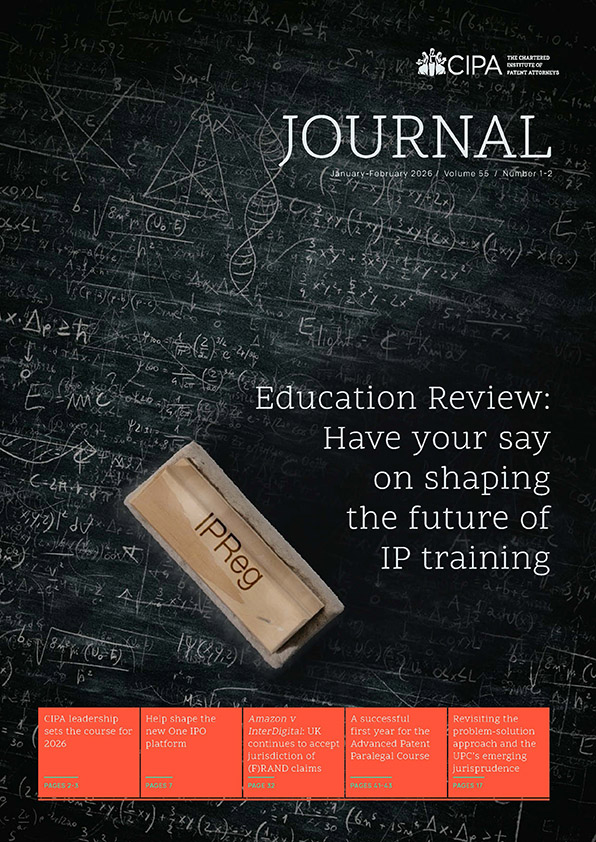
The launch of CIPA’s Advanced Patent Paralegal Course in 2025 marked a long-awaited step forward for experienced paralegals. In this personal and practical account, Lucie Jones reflects on taking the APPC for its inaugural year – balancing study with work and home life, testing new ways of learning, and discovering how the course recognises the depth, judgement and expertise required in modern patent paralegal practice.
The Advanced Patent Paralegal Course (‘APPC’), created for experienced patent paralegals, finally launched in 2025. After years in the making, I was far too excited about a course that actually reflects the work we do every day, and acknowledges just how much paralegals bring to a strong, well‑managed patent portfolio, to miss the chance to sign up.
I am pleased to report that not only did it live up to expectations, it also didn’t break me, my schedule, or my will to live. Here is my take on the course, told exactly as it felt while balancing a new role, a home that runs on organised chaos, and the constant challenge of fitting in any kind of self‑care.
The APPC currently consists of four core modules: GB, EP and PCT patent prosecution, plus Professional Conduct and Ethics, with more modules planned for the future.
It is assumed that candidates already have the knowledge from the Introductory Patent Paralegal Course (IPPC) or its earlier versions. I completed mine a full decade ago, so I was slightly concerned that my memory would be too rusty, but it wasn’t an issue. If anything, my day‑to‑day experience turned out to be just as useful, if not more, than anything I learnt all those years ago.
The course isn’t built on memorisation (excellent news for my perimenopausal brain). Instead, it taught me how to find the right information, interpret it, and apply it in real situations. It is not about being a walking EPC; it is about understanding why things are done the way they are and how the rules apply to everyday practice.
As the name suggests, this is not an introduction to patents. You need a solid grounding in everyday practice before you start, the kind of practical experience you get from actually working in the profession, not reading about it. CIPA even recommends a minimum of three to four years’ post‑introductory course experience. Although the level is advanced, I found it built on what I already knew, rather than throwing me in at the deep end.
The format is built for people who don’t get uninterrupted days, which is to say, every patent paralegal everywhere.
One of the most useful features of the APPC is the series of small, focused webinars. They are pre‑recorded, so I could watch them anytime, on my lunch break, in the evening, or whenever life finally quietened down for a few minutes. This makes a real difference when trying to fit studying around an already full week. Short, flexible and genuinely helpful, the webinars made the course feel structured without being rigid, and guided without taking over my schedule.
We were then given activities that test how well we use the resources and how we exercise judgement. It is not just about whether we understand the material, but whether we can use it to make the kinds of decisions we face in real practice.
There is also an activity review webinar for each module, which gave me the chance to check my understanding, see how others approached the tasks, and ask any questions that came up along the way. It pulls everything together and reinforces the learning in a very practical way.
Once the webinars and activities were completed, we moved on to an assessment for each of the first three modules. We had about a month to complete each one, which made them manageable alongside work. I did make a point of starting early though. They were certainly not the kind of assessments you leave until the night before!
A large part of the APPC involves finding the correct answers yourself. You can search online. In fact, you are expected to, and the course gives you plenty of support to do it properly. You are encouraged to find the relevant legal texts, to learn how to navigate the EPO and UK IPO resources, and the PCT Applicant’s Guide, to track down the information you actually need. I strongly believe these are the skills that matter most, in the course and in real practice.
As a shortcut, I started out using the EPO’s AI tool, the Legal Interactive platform, which gave me quick access to the legal texts. It was incredibly helpful, until it wasn’t. Sometimes the results were exactly what I needed. Other times they sent me in completely the wrong direction.
At some point I realised that Copilot was giving me clearer and more accurate results. This was not something I ever thought I would admit publicly, yet here we are. The tools will keep evolving, but the core skills of online searching remain the same: how to look things up and make sure they stand up to scrutiny, whatever tool you happen to be using.
One of the most reassuring parts of the course is the mentoring system. A mentor is not mandatory, but I would not attempt the APPC without one. In fact, I would happily recommend having two if you can, or more! Mentors can be patent attorneys or senior paralegals or any experienced IP professional.
My main mentor was a patent attorney whom I genuinely consider a genius, which made what happened next even more satisfying.
He still checked answers. Not because he did not know his job, but because the questions were demanding and no one, not even a genius, can memorise everything in this profession. Patent practice is complex, detailed and always evolving. Watching an expert flip through the EPC was a clear reminder that good practice is not about having every rule memorised. It is about knowing how to track down the right information and check it properly. Seeing that in action showed me that this is a skill I can develop too.
Being able to discuss the assessments with him made a real difference. It reduced my stress, cut the second guessing and gave me far more confidence that I could pass the course.
I also asked another attorney to give me and my colleagues a demonstration of how to use the PCT Applicant’s Guide properly. This turned out to be one of the highlights of my training.
As this was the first year of the APPC, I did not have the option of being mentored by a past candidate. I suspect that will become a real asset for future cohorts and would strongly recommend it if the opportunity is there.
When I signed up for the APPC, I did it with a mix of excitement and mild panic about how I would fit it into everything else I juggle. Looking back now, I am glad I took the chance. The course sharpened the skills I rely on every day and helped me see the broader impact of the work I already do. It brought structure to the knowledge I had gathered over the years and gave me more confidence in my day-to-day responsibilities.
Most of all, it reminded me why I wanted this course to exist in the first place. The APPC finally reflects the depth of the paralegal role and acknowledges how much thought, judgement and legal understanding our work requires. For me, that recognition was worth every hour I put into it.
If you want to give the APPC a try yourself, you can find full details about the 2026 course here. Registrations run from 9 February to 13 March 2026. CIPA will also be holding a webinar on 3 March 2026 for anyone who wants an overview before signing up: see here.
Lucie Jones is Head of Client Services at EIP and chair of the IP Paralegals Committee.
Simon Wright
Vicki Salmon
Patents Committee
CIPA
Debbie Slater
Lee Davies
Lee Davies
Simon Wright
Vicki Salmon
Patents Committee
Greg Corcoran, Nicholas Fox, Rose Hughes
CIPA
IPO update
Anna Hatt
Beck Greener LLP
Bristows
David Pearce, Mike Snodin
Bristows
EIP
Lucie Jones
Annemarie Parsons
Dóra Máté, Jemma Law
Annalia Bertelli, Rosie Brown, Jo Reeves-Smith
Annemarie Parsons
Emily Harris
CIPA
IPReg
PatWorld
Annemarie Parsons
Juliet Redhouse
Marek Blaszyk, Matty Philpotts
Samantha Funnell
CIPA
Jonathan's Voice
Anne Burgato