USPTO issues request for comments on experimental use exception
Mary C. Till and Amanda K. Murphy



In2scienceUK supports young people from low-income backgrounds to gain essential insights into science, technology, engineering, and mathematics (‘STEM’) research and careers. By providing bespoke work placements, research activities and career support, young people progress to further education and STEM careers with the support of dedicated professional mentors. In2scienceUK aims to support greater innovation and diversity within the UK STEM and IP sectors through the inclusion of underrepresented groups.
The young people who take part in the In2Stem Programme are recipients of free school meals, a key indicator of childhood poverty in the UK and live in areas in which progression to higher education is low. These young people are less likely to progress to further education and skilled careers. In2scienceUK removes the barriers to STEM relevant experience placements and enables young people to gain the skills needed to progress and reach their full potential. Furthermore, with salaries 20% higher in STEM careers compared to other sectors and an increasing industry demand for STEM skilled workers, In2scienceUK aims to provide young people with a better future through long-term social mobility.
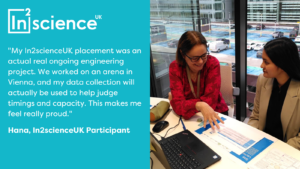
The In2Stem Programme provides participants with work placements created in line with their specific career interests and includes real STEM research conducted with the support of volunteer professionals. Young people receive essential outreach and skills workshops to support them with university applications, career support and interview skills. The combination of research-level STEM education and engagement with positive role models is essential in supporting the development of confidence in young people. By providing young people with highly focused research skills and outreach experiences In2scienceUK introduces beneficiaries to the varied career pathways available in both the STEM and IP sector.
Recent statistics published by the Department of Education concluded that only 28% of students who are recipients of free school meals progress to university. The most recent evaluation of In2scienceUK’s UCAS STROBE data concluded that 85% of In2scienceUK participants accepted a place at university and that In2scienceUK participants had a significantly higher rate of application acceptance at higher tariff universities. This shows how many young people from low-income backgrounds are being prevented from progressing to higher education due to the lack of relevant placement opportunities, skills outreach and support networks. By working with a diverse range of STEM and IP organisations, In2scienceUK increases the number of placements available to young people and supports innovation by delivering placements focusing on expanding areas of science including AI, machine learning and computer science.
The Intellectual Property Office’s Inclusion & Diversity Report 2022-2023 highlights the need for greater gender equality and access to specialist skills engagement activities to attract those from underrepresented groups into the IP sector. In2scienceuK is committed to supporting greater inclusion by conducting outreach to underrepresented groups. In 2023, 81% of programme participants were from ethnic minority backgrounds, and 71% were female. By working in collaboration with In2scienceUK, leading IP industry partners are introducing diverse groups of young people to careers in IP and contributing to social mobility through public engagement. IP partners are enabling young people to discover career pathways in IP for the first time and enabling greater information sharing with those with limited access to further opportunities.
In2scienceUK would like to thank current IP law partners for enabling In2scienceUK to expand and give more young people the opportunity to pursue degrees and careers in STEM and IP across the UK. Since 2020 In2scienceUK’s IP partners have contributed significantly to social mobility by enabling over 150 young people to access the support they need to efficiently progress to skilled careers. We are proud to be partnering with the following IP firms and industry regulatory partners:
Every year In2scienceUK receives over 3000 applications from young people passionate about STEM careers. In2scienceUK aims to support as many young people as possible by increasing the number of available placements each year. If your firm would like to partner with in2scienceUK by sponsoring a cohort of young people, providing insight into careers in IP and supporting greater diversity within the sector, please email Luke McKelvey, In2scienceUK’s dedicated Development Manager, [email protected]
Mary C. Till and Amanda K. Murphy
Sam Walters and Paul Kaufman
Molly Harte and Paul Kaufman
Greg Corcoran, Brenda Holmes, Takahiro Koshibu and Toby Mak
Lee Davies
Lee Davies
Lee Davies
Lee Davies
Emily Jones
Emily Jones
IPO Update
Isabella Fish
Iain Ross
Iain Ross
Simon Davies
Greg Corcoran, Brenda Holmes, Takahiro Koshibu and Toby Mak
Bruce C. Dearling
Mary C. Till and Amanda K. Murphy
Ian Mirandah and Hilmi Zaini
Daniel Wise
Natalia Wegner
Sam Walters and Paul Kaufman
Sudarsan Rajagopal (Fellow) and Fergus Tyrrell
Molly Harte and Paul Kaufman
John Hull, Anna Hatt, Deborah Hart, Matthew Ng and Sarah-Jane Crawford
David Pearce
Claire Phipps-Jones, Kathryn Hambly, Rachael Cartwright and Hannah Rigby
Darren Smyth, Monika Rai, Joanne Welch, Schi-Hwa Chae, and Felix Hutt
Khushbu Solanki and Ellis King
Lucie Jones
Dóra Máté
JoAnna Emery
Meera Taank
Luke McKelvey
Andrea Brewster
Informals Committee
Bod Ogunrinu-Peters