

- News
- News
- NewsMedia
- Events
- Events
- EventsIntroductory Patent Paralegal CourseAdvanced Patent Paralegal Course (APPC)
- Advice
- Advice
- IP explainedResources
- Members
- Members
- MembershipBrand & Marketing Materials
- Publications
- Publications
- Online ShopCIPA JournalDownloads
- Jobs
- About Us
×12. European Qualification System
Student Handbook
 Student handbook 12. European Qualification System
12. European Qualification System
There are five key requirements to becoming qualified as a European Patent Attorney (EPA):
i. A STEM degree — wherein at least 80% of the degree was STEM;
ii. Professional activity;
iii. Registration of your professional activity;
iv. Enrolling in and passing the European qualifying examination (EQE); and
v. Residency and nationality.Before considering these five requirements in detail, it is important to note that the EQE will be in transition until March 2027. The new EQE, which contains foundation paper F and main examination papers M1 to M4, will gradually roll out from March 2025 and the last opportunity to sit the main examination papers A to D of the old EQE will be in March 2026. There are transitional provisions for candidates who have already taken, but not fully passed, the old EQE.
- The new EQE is detailed in the Regulation on the European qualifying examination (REE) and Implementing provisions to the REE (IPREE) which apply from 1 January 2025, link.epo.org/elearning/SupplPub2025
- The previous EQE is detailed in the REE and IPREE which applied from 1 January 2009 and were republished in 2019,
see here. - There is a useful article explaining the transition in detail here.
I. STEM Degree Requirement
The STEM degree requirement has not changed with the implementation of the new EQE. Thus, any decisions regarding admission to the EQE continue to be based on the conditions laid down in Article 11(1)(a) REE and Rules 11 to 14 IPREE.
The IPREE states that a candidate can be registered to take the EQE ‘provided they possess at least a university-level scientific or technical bachelor’s degree, or any equivalent academic degree’ (Rule 11) in any one of ‘biology, biochemistry, chemistry, construction technology, electricity, electronics, information technology, mathematics, mechanics, medicine, pharmacology and physics’ (Rule 13). Importantly, Rule 11(2) states that ‘the academic degree…shall have been awarded at the end of a full-time course with a minimum duration of three years. At least 80% of the course hours taken to obtain this degree shall have been devoted to scientific and/or technical subjects’. Thus, if your degree is in a subject like Geology, Geophysics, Physics & Music, or Mathematics & Philosophy, you will need to prove that you spent at least 80% of your time studying the technical/scientific parts. Otherwise, you will need at least ten years’ experience of professional activity before being eligible to sit the EQE.
II. Professional Activity Requirement
In addition to the STEM degree requirement, there is a professional activity requirement which must be completed before you sit the EQE. There are three different routes to fulfilling this requirement which are similar to the practice requirement for the UK examinations:
a. training under the supervision of a qualified European Patent Attorney;
b. representing your employer before the EPO; or
c. working as an EPO examiner.More details of the requirements of each route are set out below but it is noted that the first route is the most common route.
For the old EQE, you must have completed at least three years of professional experience by the date of sitting papers A to D. In other words, you will need to have started a full-time period of eligible professional activity before March 2023 to be eligible to sit the final set of papers A to D in 2026.
The professional experience requirements are different in the new EQE because the examinations can be taken in a modular fashion over three years. Going forwards, Article 11(2)(a) states that at the time of sitting the examination, candidates must have performed one or more of the professional activities for a duration of:
- at least one year for taking the foundation paper F,
- at least two years for taking the main examination papers M1 and M2, and
- at least three years for taking the main examination papers M3 and M4
It is also possible to take all the main examination papers together after three years without taking the foundation paper but, if the candidate does not pass all four papers, they will be required to take the foundation paper.
Please note that each of these periods of professional activity must be completed in one or more of the contracting states of the EPC and only professional activities amounting to a minimum period of three months with at least 50% part-time involvement can be counted (Rule 15). Furthermore, if you are not working full-time, the durations listed above will be increased.
II.i. Training under an EPA (Private Practice or In-House)
Article 11(2)(b)(i) REE specifies that a candidate must have ‘completed a full-time training in one of the EPC contracting states under the supervision of one or more persons entered on the list of professional representatives before the EPO, as an assistant to that person or those persons, including taking part in a wide range of activities pertaining to European patent applications or European patents’.
Your supervisor will be required to complete a certificate to confirm that you are training under their supervision.
II.ii. Representing Your Employer (In-House)
Article 11(2)(b)(ii) REE recognizes the professional activity of candidates who are doing ‘the EPC contracting states, including representing that employer before the EPO in accordance with Article 133(3) EPC and taking part in a wide range of activities pertaining to European patent applications or European patents’. Please note that this type of professional activity only applies to in-house/industry trainees who are not training under an EPA.
Your employer will also be required to complete a certificate to confirm that you are working for them and this certificate must also be accompanied by a general authorization signed by your employer and a list of European Patent Applications or patents for which you have represented your employer before the EPO. Please note that the period of professional activity will not begin until you have used the general authorization to file something in your own name on behalf of your employer at the EPO.
General authorisation. Editable EPO form 1004.
II.iii. Working as an EPO Examiner
Article 11(2)(b)(iii) lists a third type of professional activity which is ‘full-time work as an examiner at the EPO’.
Article 14(2) REE further specifies that candidates who rely on this type of professional activity to sit the examinations will not be deemed to have passed the examination until ‘they have spent at least one year in any of the capacities defined in Article 112(b)(i) or (ii)’. In other words, Examiners are required to gain a further year of experience either under the supervision of a qualified EPA or whilst representing an employer with a general authorisation.
III. Registration of Professional Experience
Rule 28 IPREE specifies that candidates ‘intending to enrol for the EQE for the first time must register once they have started a professional activity within the meaning of Article 11(2) REE’. Please note that registration is a separate step from enrolling for any examination paper. Each year, the Examination Secretariat specifies two separate deadlines:
- the registration deadline, which is the deadline by which candidates who wish to enrol in an examination paper for the first time must be registered; and
- the enrolment deadline for enrolling in one or more examinations, assuming that you are already registered.
The registration deadline is much earlier than the enrolment deadline, for example the registration date for the March 2025 foundation paper F is 28 May 2024 and the enrolment deadline is 23 September 2024. The Informals post regular reminders about these deadlines on the The Yellow Sheet, The Official Blog of the Informals Committee, but it is recommended that candidates register shortly after starting work.
Registration is done via the EQE portal and requires payment of the appropriate fee and submission of various documents, including:
- a certified copy of a valid ID or passport
- a certified copy of academic qualifications
- a certificate of training or employment, TrainingForm_EN.pdf (epo.org)
- additional documents if not training under the supervision of an EPA
IV. Enrolling for and Passing the Examination Papers
Enrolment for the examination papers is done through the same portal as registration. The enrolment window is normally open between July and September of the year preceding the examination. Enrolment requires payment of the appropriate fee(s). lease make sure that this is paid before the enrolment window closes otherwise you will have to wait another year to sit the examination.
Whilst the EQE is in transition, some candidates will be able to choose whether to sit the new or the old EQE. There is a useful article explaining the different routes in detail here. Please note that, once you sit one of the new examination papers, you will no longer be able to sit any of the old examination papers.
There are five papers in the old EQE:
a. Pre-examination
b. Paper A – Drafting Claims & Introduction for an EP application
c. Paper B – Preparing a Response to an Examination Report
d. Paper C – Notice of Opposition
e. Paper D – Legal QuestionsThe content of each main examination paper is defined in Rules 23 to 26 of the previous version of the IPREE. More information, including past papers with mark schemes, can be found on the EPO website here.
The last pre-examination was held in 2024 and papers A to D will be offered in 2025 and 2026 only. Candidates who would have been eligible to sit the pre-examination in 2025 will be exempt and can enrol for the main examination papers in 2026 if they meet the professional activity requirement. Candidates who wish to enrol in any of Papers A to D in 2025 will need to have passed the pre-examination and completed a three-year period of professional activity by March 2025.
For the new examination, there are also five papers:
a. Foundation Paper F
b. Main Examination Paper M1
c. Main Examination Paper M2
d. Main Examination Paper M3
e. Main Examination Paper M4Each of these papers is defined in Article 1 of the new REE as set out below.
a. Paper F assesses whether a candidate can apply legal concepts and provisions of the EPC and the PCT.
b. Paper M1 assesses whether the candidate can carry out tasks relating to the analysis and assessment of information and evaluate and act on instructions from a client. It further assesses whether the candidate can understand an invention and/or data provided by the client, assess the invention in view of prior art and analyse whether the invention and the application or patent comply with the provisions of the EPC.
c. Paper M2 assesses whether the candidate can apply procedural and substantive patent law of the EPC and the PCT in both day-to-day and exceptional situations arising in the practice of professional representatives in proceedings before the EPO. It further assesses whether the candidate is familiar with all procedures established by the EPC and the PCT and with the procedural law referred to as forming part of the examination syllabus.
d. Paper M3 assesses whether the candidate can assess, draft and develop patent documentation and submissions, based on documents and instructions from the client. It consists of three parts, each requiring a free-text answer:i. Part 1 of paper M3 requires at least the drafting of claims
ii. Part 2 of paper M3 requires the candidate to develop and present arguments showing why the invention and the application or patent comply with the requirements of the EPC or the PCT, and to amend claims if necessary.
iii. Part 3 of paper M3 requires the candidate to develop and present arguments showing why the invention and the application or patent do not comply with the requirements of the EPC or the PCT.e. Paper M4 assesses whether the candidate can provide an answer in the form of a legal opinion responding to an enquiry from a client. The candidate is expected to reason, present and manage advanced procedural and substantive aspects of patent law.
A slightly longer definition is also found in Rules 23 to 26 of the new IPREE and more information will be available on the EPO website.
Paper F, like the pre-examination, is auto-scored and thus it is expected that results will issue within a few weeks of sitting the examination. Papers A to D are free-text answers which are marked by two examiners and thus results are typically issued three months or so after the examination. A similar time frame for obtaining results is expected for papers M1 to M4. In the old system, there was a fixed pass mark of 50 and a compensation system to allow candidates with between 45 and 49 in one or more papers to pass the EQE as a whole as long as they have a total of 200 marks in the four papers. In the new system, the fixed pass mark has been removed and it is necessary to obtain a pass mark for each paper (and each part of M3) to pass the EQE as a whole.V. Residency and Nationality Requirement
Article 134(2) EPC states that a person who has passed the EQE can be entered on the list of European patent attorneys only if that person (a) is a national of an EPC-contracting state (e.g. the UK), and (b) has their place of business or employment in an EPC-contracting state. That is, they must be both a national of and a resident in an EPC-contracting state.
Although this is a requirement to be entered on the list, the nationality requirement is not a requirement to be able to sit the EQE. Thus, for example, you could sit the exams as a non-EPC member state national, but you must normally have EPC member state nationality after qualification if you want to be added to the register of EPAs.
Article 134(7) EPC does allow the President of the European Patent Office to grant exemptions from the nationality requirement in special circumstances. Such an exemption might be granted if a person has lived in an EPC-contracting state for a considerable period of time, is employed as a patent attorney in that state and has demonstrated an intention to stay there permanently and practise as a European patent attorney there. This is more common than you’d perhaps initially think.
VI. Exemplary Timeline for a Trainee Starting in the Profession in Autumn 2024
The diagrams below may help you to visualise the various steps in the path to becoming dual-qualified (UK-CPA/RPA & EPA).

VII. Transitional Provisions
The rollout of the new EQE and the wind down of the old EQE is shown below.
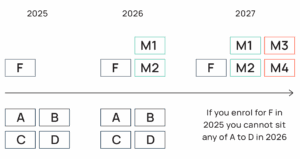
It is recognized that not all trainees who take the old EQE will be fully qualified by 2026 and there are transitional provisions to credit candidates for their existing successes as shown in the table below:
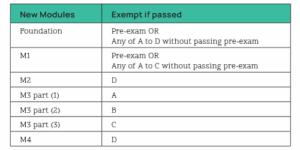
It is important to note that, although a new candidate must pass all parts of M3, partially qualified candidates only need to sit the parts of M3 covering the skills in which they have not yet been successful. Please also note that to qualify for the exemption, you need to have a score of at least 50.
Contents
Shopping Bag (0)