
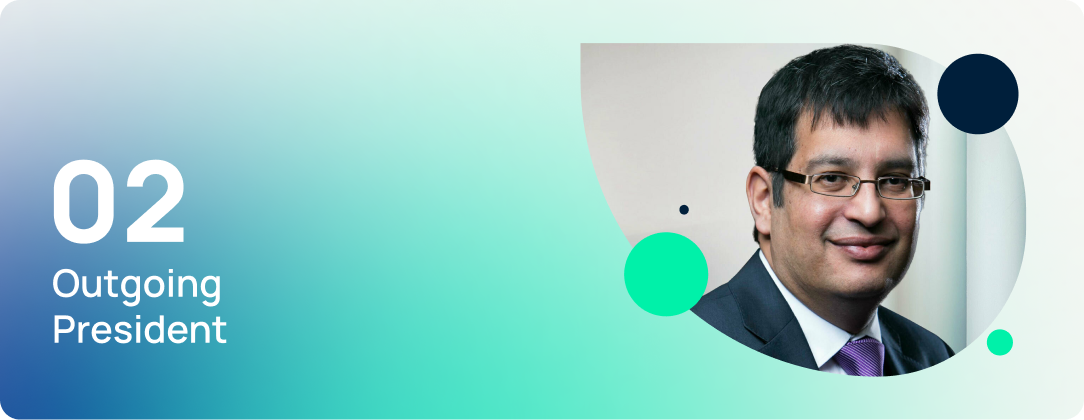




On Wednesday 5 November 2025, at the 143rd Annual General Meeting of CIPA, Simon Wright was confirmed as President with effect from 1 January 2026. Outgoing President Bobby Mukherjee reviewed his 12 months of leading the profession.
The President, Bobby Mukherjee, reflected on his term of office, which concluded on 31 December 2025, and expressed gratitude for the opportunity and privilege to have served CIPA. He extended congratulations to Simon Wright, President-elect, and Vicki Salmon, Vice-President-elect, and thanked members for their trust and support throughout the year.
Bobby observed that CIPA continues to ‘punch above its weight’, maintaining progress in challenging times through improved engagement with UK government departments and international bodies. He emphasised that CIPA’s achievements reflect shared leadership across the organisation, through Council, officers, committee members, volunteers and staff, and he thanked all for their work and commitment to the profession and to UK plc.
He described CIPA as unique in the global IP community, with an outstanding reputation, heritage and camaraderie that deserve celebration. His principal priority during the year had been to strengthen engagement with the membership, particularly ensuring that the voice of industry members is better heard. He reported on extensive visits to in-house teams across the UK and the reinstatement of the in-house leaders forum, which had been well received.
In the first half of the year, he undertook one-to-one meetings with Council members and committee chairs to gather feedback, leading to the introduction of regular committee chair meetings and governance training. He also highlighted a strategic planning event held in Portsmouth in July, led by the Chief Executive Lee Davies, with Council members and committee chairs contributing to the future direction of CIPA.
Referring to matters raised at the previous AGM, Bobby expressed satisfaction that work undertaken since then had successfully helped preserve the rights of in-house patent attorneys to represent their employers before the Unified Patent Court (‘UPC’). He cited the Court of Appeal decision in Suinno v Microsoft, which rejected a blanket ban on in-house representation and aligned with the positions CIPA had advocated in its open letter.
Bobby reported on a ‘sold-out’ CIPA Congress in Bristol, attended by over 200 delegates and themed around AI and IP, which also celebrated the tenth anniversary of IP Inclusive. He noted increased attendance across all conferences during the year, including the UPC, CTC and Paralegal events, indicating that members valued the topics chosen. He also participated in the Student Conference in Manchester and regional member events in Cambridge, Leeds, Manchester, Glasgow and Bristol.
He reiterated the importance of collaboration between industry and private practice, noting that CIPA’s work with government continues to support a world-class IP framework that drives innovation, jobs and economic growth. He welcomed the Government’s decision to retain the UK+ exhaustion rights regime, which CIPA had advocated before the All-Party Parliamentary Group on IP, and outlined CIPA’s continuing engagement in policy development on AI, standard essential patents, UK designs, privilege and trade.
Bobby cited CIPA’s collaborative approach as instrumental in influencing positive outcomes such as the CPTPP trade negotiations, where CIPA and the IP Federation secured appropriate IP carve-outs for the UK. He referred to the joint CIPA and IP Federation intervention in the Emotional Perception UK Supreme Court case, concerning the patentability of artificial neural networks, an issue of growing importance as AI advances.
He also warned against international ‘anti-IP’ initiatives, including IP waivers and compulsory-licensing proposals, identifying green technologies as the next likely target. CIPA had been working with the Government, WIPO and others in preparation for the WTO Ministerial Conference (MC14) in Cameroon in March 2026, to promote the value of IP protection through evidence-based examples.
CIPA, the International Chamber of Commerce (‘ICC UK’) and the IP Federation had produced influential reports on how patents drive innovation and economic growth, particularly in the green-tech sector, which were presented at the WTO and WIPO in Geneva during 2025 and received highly positive feedback. The ICC described this as a ‘best-in-class collaboration’.
Turning to professional development, Bobby reported significant progress on the creation of new structured vocational pathways into the IP profession, including IP apprenticeships for paralegals and patent attorneys. He described this as vital to improving social mobility and broadening access. The initiative, launched in January 2024, was progressing well under the leadership of Annmarie Parsons (Paralegal Level 3 Apprenticeship) and had seen approval of the Patent Scientist/Engineer Level 6 Degree Apprenticeship proposal earlier in 2025, with a target launch in 2027. He emphasised that these schemes could transform lives and strengthen the profession by drawing talent from a wider pool, funded through the apprenticeship levy.
Bobby reaffirmed that CIPA continues to deliver on its wider strategic objectives: engaging and supporting SMEs; maintaining productive relationships with IPReg and key domestic and international stakeholders; and ensuring that UK patent attorneys retain a key role before the UPC. He noted that it may be time to consider whether the UK should re-join the UPC, provided political and business support exists, a position he personally endorsed.
Bobby also reported on productive engagements with international partner organisations, including the Japanese Patent Attorney Association, the Japan Intellectual Property Association, the Intellectual Property Institute of Canada (‘IPIC’), the Korean Patent Attorneys Association (‘KPAA’), the Patentanwaltskammer, the US Intellectual Property Owners Association, and the American Intellectual Property Lawyers Association. Bobby noted that the KPAA and IPIC had made reciprocal visits to London. These relationships, he said, exemplify mutual respect and valuable collaboration, particularly in CIPA’s ongoing support for IPIC in its work on legal advice privilege issues arising in the Janssen case in Canada.
In closing, Bobby thanked his employer, BAE Systems plc, for supporting his presidency, describing the experience as a ‘once-in-a-lifetime opportunity’.